Last updated October 9, 2026
DIY vs Professional ADU: The Los Angeles Homeowner’s Decision Guide
LA County recorded over 1,800 unpermitted ADU complaints in 2023, and the most common source wasn’t a shady contractor working under the table. It was a homeowner who pulled a permit for a “storage room” or “workshop” and quietly finished it into a rental with a bed, a bathroom, and a hotplate. By the time the city noticed, that “money-saving” project had become a legal liability that made the property unsellable until it was fixed. This guide walks you through what Los Angeles actually lets you do on your own property, where the law draws a hard line, and how to decide when saving money on labor becomes losing money on legal exposure. For more guides & resources on ADU construction, explore our blog.
Quick Answer
In Los Angeles, a motivated homeowner can legally handle interior finishing, landscaping, and owner-supplied fixtures on an ADU project, but structural framing, foundation work, electrical, plumbing, and anything that requires a Class B or Class C contractor license should be left to professionals. The real question isn’t whether you can DIY parts of the job. It’s whether the $15,000 to $40,000 you might save on labor is worth the risk of a demolition order, a failed inspection, or a “legalization” bill that often runs $40,000 to $90,000 when you try to sell.
Table of Contents
- What Los Angeles Law Actually Lets You Do Yourself
- The Owner-Builder Permit: What It Really Means and Why Lenders Hate It
- The Hidden Cost of DIY ADU Attempts: Demolition Orders, Re-Submission Fees, and Legalization
- Three Scenarios Where DIY Genuinely Saves You Money Without Legal Risk
- The Written Contract: Why Even Homeowners Hiring Subs Need Paper Trails
- Prefab vs Site-Built: How the Build Method Changes the DIY Math
- Common Mistakes to Avoid
- When to Call a Professional
- Frequently Asked Questions
What Los Angeles Law Actually Lets You Do Yourself
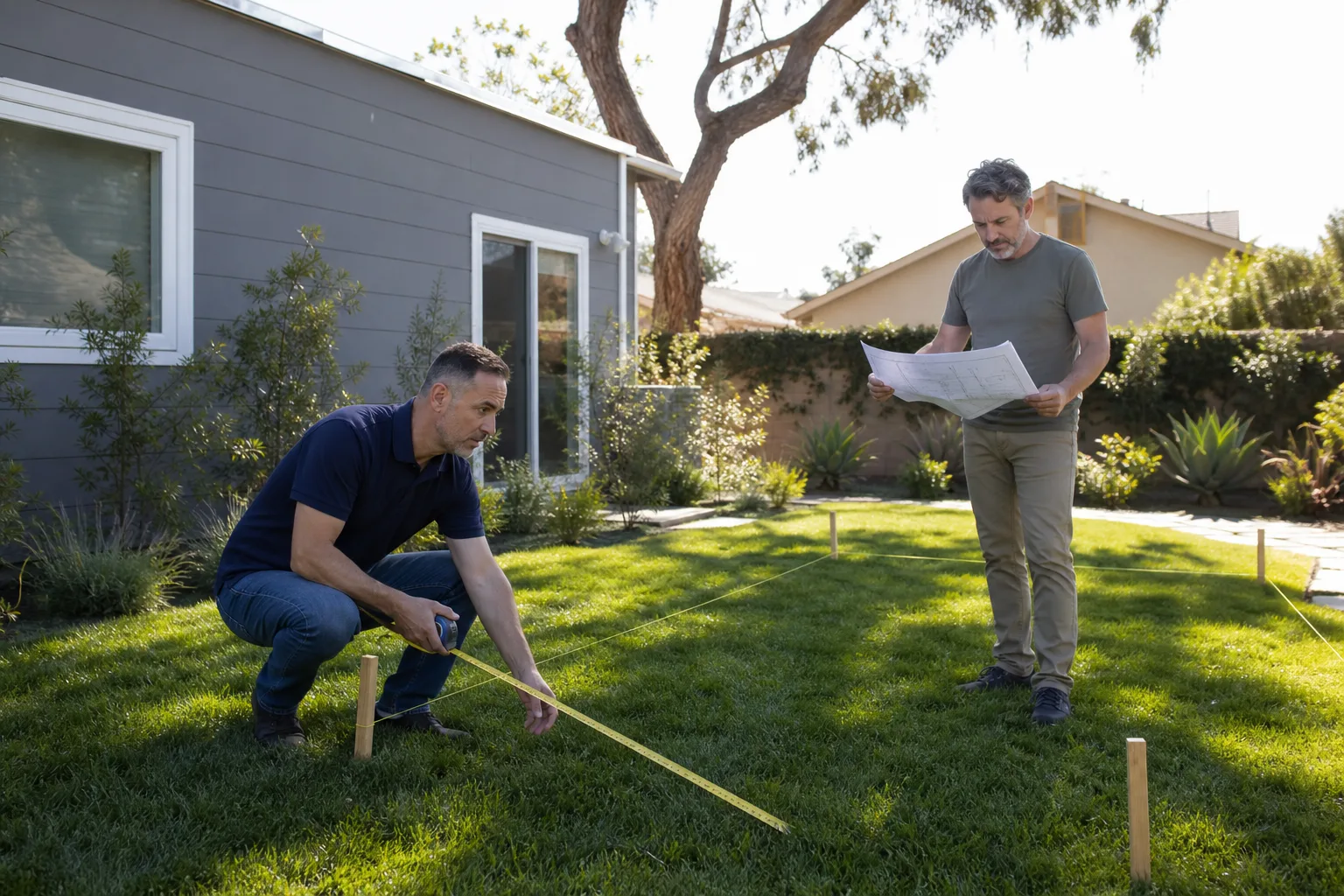
California’s Business and Professions Code is surprisingly permissive about what an unlicensed person can do on their own property. The key phrase is “owner-occupied” and “personal residence.” If you live in the home and the ADU is on the same lot, you can act as your own general contractor for certain scopes. But the moment you hire workers, pay them wages, and act as their boss, you’re operating as a contractor. That requires a license if the total contract value exceeds $500 for anyone who works on someone else’s property. On your own property, the rules bend, but they don’t break.
Here’s what an unlicensed homeowner in Los Angeles can legally do with an ADU project:
- Interior finishing after rough inspections pass: painting, trim, flooring, cabinet installation, and baseboards are fair game. The rough-in inspections for electrical, plumbing, and framing already happened, so you’re not touching anything structural or hazardous.
- Landscaping and hardscape: grading a yard area, building a paver patio, planting drought-tolerant landscaping around the ADU, and running exterior drainage away from the foundation are all tasks that don’t require a licensed contractor.
- Owner-supplied fixtures: you can buy the toilet, sink, faucet, light fixtures, and ceiling fans yourself. You cannot install them if the installation requires modifying plumbing or electrical rough-ins. A licensed plumber or electrician must make those connections.
- Demolition of non-structural items: pulling out old drywall, removing cabinets, tearing up carpet, and clearing a garage space are fine. Structural demolition, like removing a load-bearing wall, is not.
Where the law kicks in hard is anything that touches the structural integrity, life-safety systems, or the public utility connections of the ADU. In Los Angeles, that means foundation excavation, concrete pours, framing, shear wall installation, roof structure, electrical panel work, gas line extensions, sewer connections, and any work that requires a building permit with a licensed professional’s signature on the plans. The city checks for this. LA’s Department of Building and Safety (LADBS) requires that plans for new ADUs be stamped by a licensed architect or engineer, and it verifies the license of the contractor who pulls the permit. If an unlicensed person’s name appears on the permit application in the wrong capacity, the application gets rejected, often with a note that sends people scrambling to hire someone fast.
The Owner-Builder Permit: What It Really Means and Why Lenders Hate It
California lets homeowners pull an “owner-builder” permit, which declares that you, the property owner, are acting as your own general contractor. It sounds empowering, and in some cases it is. But it carries a legal and financial weight that most Los Angeles homeowners don’t understand until it’s too late.
An owner-builder permit in California is specifically designed for people who plan to do the work themselves or directly hire and supervise subcontractors. You can’t pull an owner-builder permit and then hire a contractor to run the job under the table. That’s illegal and voids both the permit and your insurance. You also can’t pull an owner-builder permit with the intent to sell the property immediately after completion. California law requires a 12-month owner-occupancy period before you can legally sell a property built under owner-builder status. Lenders know this.
Why lenders hate seeing owner-builder on title:
- Construction defect liability: when a licensed contractor builds an ADU, their license, bond, and insurance stand behind the work for years. When an owner-builder builds it, that liability disappears. The buyer inherits any hidden defect, and the lender is left with a property that’s harder to underwrite.
- Appraisal complications: appraisers assess owner-built structures more cautiously, often discounting the value because they can’t verify the quality of the work through a contractor’s track record and warranty.
- Title insurance exclusions: title companies frequently exclude coverage for unpermitted or owner-built work if they suspect the scope exceeded what the permit allowed. A buyer’s lender will catch this during escrow and may refuse to fund.
- Refinance friction: if you plan to pull equity out of the property later, an owner-built ADU complicates the appraisal and can delay or derail the refinance.
In our experience in Los Angeles, we see owner-builder permits work well for two types of homeowners: people who genuinely have construction trade experience and plan to do most of the labor themselves, and people building very small structures like a 400-square-foot studio where the risk is proportionally small. For everyone else, the owner-builder route often becomes a slow-motion problem that shows up at exactly the wrong moment: when you’re trying to sell or refinance.
The Hidden Cost of DIY ADU Attempts: Demolition Orders, Re-Submission Fees, and Legalization
The headline number people share when talking about DIY ADU savings is $40,000 to $80,000 in labor costs. That number is real. But it’s a gross savings number, not a net one. The net number, after you account for the way DIY projects actually unfold in Los Angeles, is often a fraction of that. And in the worst cases, it’s negative.
Here’s the sequence we’ve seen play out across Los Angeles neighborhoods, from Van Nuys to El Sereno to South LA, more times than we can count:
- The homeowner pulls a permit for something else. It’s a “storage room” with no kitchen or bath. The inspector signs off on the rough structure, and the homeowner thinks they’ve outsmarted the system.
- The conversion happens quietly. A bed goes in. Then a hotplate. Then a mini-split. Then someone runs a garden hose to an improvised sink, or taps into an existing plumbing line without an inspection.
- The complaint arrives. A neighbor notices increased traffic, noise, or cars parked on the street and calls 311. LA’s code enforcement responds to unpermitted dwelling complaints faster than almost any other category because illegal units are a top political priority.
- The inspector finds violations. No plumbing permit, no electrical permit, no means of egress that meets code, no smoke detector properly wired, often no carbon monoxide detector. Each violation carries a fee.
- The order arrives. The city issues a Notice to Comply, then a Stop Work Order, then potentially an Order to Vacate or a Demolition Order if the violations are severe enough.
- The fix cost lands. You now have to rip out the unpermitted work, submit new plans, pay retrofit fees that start around $5,000 to $12,000 for plan check re-submission, and then rebuild the work with a licensed contractor, under the watchful eye of an inspector who now knows this property has a history.
The total “legalization” cost when you try to sell a property with an unpermitted ADU in Los Angeles? Based on our experience and conversations with listing agents and brokers, it often lands between $40,000 and $90,000 once you factor in demolition, rebuild, permits, inspections, upgraded utilities, and the carrying costs of a property that can’t close escrow until the work is legit. And that’s if the city lets you legalize it at all. Some conversions get ordered to be fully demolished because the foundation, setbacks, and fire separation aren’t just unpermitted, they’re fundamentally non-compliant and can’t be fixed without starting over.
The people who got citations for those 1,800+ complaints in LA County didn’t set out to break the law. They set out to save money. The law didn’t care.
Three Scenarios Where DIY Genuinely Saves You Money Without Legal Risk
We’re not anti-DIY. Far from it. About a third of the ADU projects we work on include some level of homeowner involvement, and we encourage it in the right places. The key is knowing exactly where the legal and safety lines are, as we explore in our DIY vs Professional Room Addition Contractor guide, and staying well on the safe side of them.
Here are three scenarios where a Los Angeles homeowner can roll up their sleeves and keep real money in their pocket without creating a code enforcement time bomb:
1. Interior finishing after the rough inspections pass
Once your electrical rough-in, plumbing rough-in, and framing inspections are signed off, the interior of the ADU is open territory for a careful homeowner. This means hanging drywall (if you’re experienced with it), taping and mudding, painting, installing trim and baseboards, laying vinyl plank or laminate flooring, and mounting cabinets. On a 600-square-foot ADU, that’s easily $18,000 to $30,000 in labor you can redirect into nicer materials or keep in savings. The catch: you need to be honest about your drywall skills. The ceiling seams on your first drywall job will be visible. If you can live with that, you’ll save real money. If not, hire that part out and do the painting yourself.
2. Landscaping and hardscape around the permitted structure
The ADU itself is permitted. The yard around it is yours. In Los Angeles, this is especially valuable work to DIY because drought-tolerant landscaping is both simple and highly visible to potential tenants and future buyers. The LA-specific details matter here: decomposed granite pathways, drought-tolerant natives like manzanita and ceanothus, mulch from the city’s free Mulch Giveaway program, and rainwater-harvesting swales are all things you can install yourself without a permit and without risk. You can also build a paver patio, create a privacy screen, and set up outdoor lighting that runs on low-voltage or solar. The savings on landscape labor typically runs $4,000 to $10,000, and they’re pure savings with zero code risk.
3. Owner-supplied fixtures installed by licensed tradespeople
You don’t have to install a water heater yourself to save money on it. You can buy the fixtures and appliances yourself, shop the clearance sales, and then have a licensed plumber or electrician make the connections. That requires a level of coordination, and you’ll need to make sure the items you buy are up to current California code (Title 24 energy compliance applies to permanent fixtures in new ADUs). But the savings is real: you might pay $200 for a faucet instead of the $600 mark-up a design-build firm would charge. A licensed plumber will install it for $150 to $250. Net savings: $200 to $350 per fixture. Do that across a kitchen and two baths, and you’ve saved thousands without touching a pipe. The key is that no unlicensed person connects anything to gas, water, or electrical lines. The purchasing is legal. The connection is not.
The Written Contract: Why Even Homeowners Hiring Subs Need Paper Trails
If you’ve decided to act as the general contractor on your ADU project and hire individual subcontractors, you’re taking on the most legally exposed role in construction. California law treats you as the contractor of record, and that means you carry the liability for the subs you hire. If an electrician gets hurt on your property and you didn’t verify their workers’ compensation insurance, you could be personally liable for their medical bills. If a framing crew walks off the job halfway through, your only recourse is whatever was written down.
In California, any home improvement contract over $500 must be in writing and include specific items: the contractor’s license number, a description of the work to be done, the total price, and a schedule of payments. But when you’re the one hiring the sub, those requirements shift onto you. You need a written contract that covers:
- Scope of work: exactly what the sub will do, what materials they’ll supply, and what’s excluded. “Frame the ADU addition” is not a scope. A detailed scope is three pages long and references specific drawings, dimensions, and materials.
- Price and payment schedule: the total amount, the draw schedule tied to completed milestones, and the final payment tied to a passing final inspection. Never pay for future work. Pay only for work that’s been completed and inspected.
- Change-order process: what happens when the sub discovers something behind the wall that changes the scope. The standard rule: no change in price without a written change order signed by both parties before the changed work begins. Without this, “scope creep” becomes “he said, she said,” and the dollar amounts are large enough to end up in small claims court.
- Insurance and licensing requirements: every sub must carry their own general liability and workers’ comp insurance and provide you with a certificate of insurance naming you as additionally insured. If they can’t, walk away. The cheapest bidder who doesn’t carry insurance is the most expensive mistake you can make.
- Timeline and lien release: a start and finish date, plus a conditional and unconditional lien release form at each payment. Every time you pay a sub, you get a signed lien release in return. Without it, a supplier or a sub can place a mechanic’s lien on your property even after you’ve paid your general contractor, because they were never paid.
This is the unglamorous work that separates a successful owner-builder from a nightmare. And it’s the reason we put every aspect of a Benson ADU Builders project in writing from the first conversation. The written price before work starts isn’t just about transparency. It’s about creating a document that protects both parties and removes the ambiguity that causes most construction disputes. A handshake doesn’t hold up in court. A contract does.
Prefab vs Site-Built: How the Build Method Changes the DIY Math
One of the biggest changes in Los Angeles ADU construction over the last five years is the rise of prefab and panelized systems. This shift matters for the DIY conversation because it changes where the labor is performed, and that changes what a homeowner might reasonably do themselves.
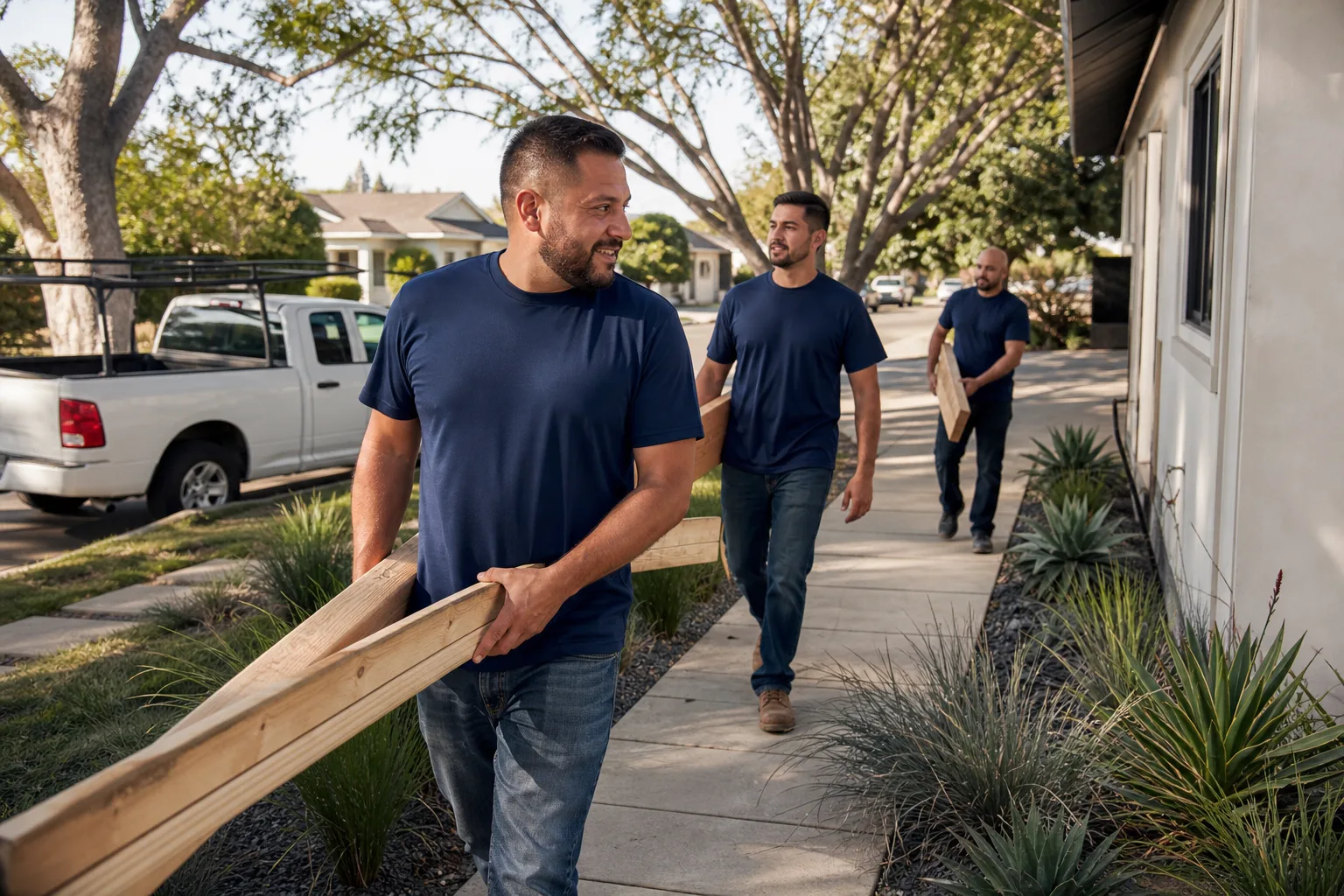
With a site-built ADU, framing happens on your property. The lumber gets delivered, the framers show up, and every wall gets cut and nailed in place. That’s a construction site with all the noise, scheduling, and weather exposure that implies. The DIY opportunities are limited because the structural work needs to be done by licensed framers, and the inspection process is sequential: foundation, then framing, then mechanicals, then drywall.
With a prefab ADU, like the units built by Dvele or Mighty Buildings, the modules or panels are fabricated in a controlled factory environment. They arrive on a truck, get craned or set into place, and the on-site work becomes mostly about connections: tying the module to the foundation, connecting utilities, and finishing the exterior. This reduces on-site construction time by 40 to 60 percent on many projects and shrinks the window where weather, theft, or scheduling chaos can derail things. It also concentrates the DIY-friendly work. A homeowner who might be overwhelmed by a five-month site-built project can often handle the interior finishing on a prefab unit that arrives with walls, roof, and windows already in place.
Boxabl takes this even further with folding units that deploy in a matter of hours rather than weeks, which radically compresses the site labor and leaves the homeowner with a structure that’s already dried-in and ready for finishing trades. Plant Prefab uses panels that get assembled on-site with far less framing labor than traditional stick-built.
What this means for the DIY-versus-professional question is simple: the build method changes where the boundaries of DIY work sit. The legal boundaries don’t change. You still need licensed trades for the foundation, the utility connections, and the final mechanical inspections. But the amount of accessible, legal DIY work gets bigger with prefab because more of the traditional construction risk is moved off-site. That’s worth considering if you’re trying to balance budget and involvement, and our maintenance schedule can help you plan for long-term upkeep after the build.
Common Mistakes to Avoid
- Pulling a permit for a “storage room” and finishing it as a dwelling: this is the single most common path to a demolition order in Los Angeles. Inspectors see this pattern constantly, and the city’s code enforcement is specifically trained to spot the signs.
- Hiring an unlicensed “handyman” for structural or system work: California requires a license for any work over $500 that involves structural, electrical, plumbing, or mechanical changes. An unlicensed person doing that work on your property puts you in a position where you’re legally responsible for any injury or damage, and your homeowner’s insurance will likely deny the claim.
- Connecting water, gas, or electrical lines yourself: this is the most dangerous DIY move, and it’s the one that causes the most expensive damage. A bad gas connection is a fire or carbon monoxide risk. A bad electrical connection is a fire risk. A bad plumbing connection is a flood risk. All three will void your insurance if they cause a claim.
- Assuming the city won’t find out: LA code enforcement, 311 complaints, and now aerial imagery comparisons from the county assessor’s office mean that unpermitted dwelling units get discovered at a very high rate. The assessor cross-references permit data with property imagery, and a “storage room” with an air conditioner and a separate entrance gets flagged.
- Skipping the written change-order process with subs: even with good subs, changes happen. Without a written change order, a $2,000 electrical change can become a $12,000 dispute. Write everything down.
- Trying to sell or refinance within a year of an owner-builder project: California’s 12-month owner-occupancy rule for owner-builder permits means you can’t sell immediately without triggering lender scrutiny and potential title issues. If there’s any chance you’ll sell within a year, use a licensed contractor.
When to Call a Professional
If your ADU project involves any of the following, the DIY conversation is over: foundation work, shoring or retaining walls, structural framing, roof structure, electrical panel upgrades, gas line extensions, sewer connections, or any work that requires an architect or engineer’s stamp. These are licensed-trade requirements in Los Angeles, and no amount of YouTube confidence changes that. The same is true if you’re planning to rent the ADU out, because a rental unit carries landlord liability that doesn’t exist for owner-occupied space. If you’re not sure where your project falls, get an expert assessment. Benson ADU Builders home offers free estimates in Los Angeles. Call (903) 568-7222 to talk through your project scope and get an honest read on what’s DIY-able and what’s not.
Frequently Asked Questions
You can act as an owner-builder on your own owner-occupied property in Los Angeles, but you may only do work that doesn’t require a licensed trade. You cannot legally perform structural, electrical, plumbing, or mechanical work yourself, and you must comply with California’s owner-builder occupancy requirements.
Legalizing an unpermitted ADU in Los Angeles typically costs between $40,000 and $90,000 when you factor in demolition of non-compliant work, new permits, plan check fees, inspection retrofits, and the cost of rebuilding with licensed trades. It’s almost always more expensive than doing it right the first time.
You’ll receive a Notice to Comply, then potentially a Stop Work Order, an Order to Vacate, and in severe cases a Demolition Order. Each violation carries fees, and the process of resolving them can take months while the property can’t be sold or refinanced.
Only if you have construction experience and plan to do a significant portion of the labor yourself. Otherwise, the owner-builder route creates title complications, lender scrutiny, and liability exposure that usually outweighs the labor savings.
Interior finishing after rough inspections pass, landscaping and hardscape around the permitted structure, and purchasing fixtures for licensed trades to install are the three safe DIY zones. Everything structural or system-related requires licensed work.
Start by asking for a written price before any work starts, verify the contractor’s license through the CSLB, and choose a company that works with established brands like ADU Builders in Los Angeles and gives you a written guarantee. Benson ADU Builders follows exactly this model on every project.
The Bottom Line
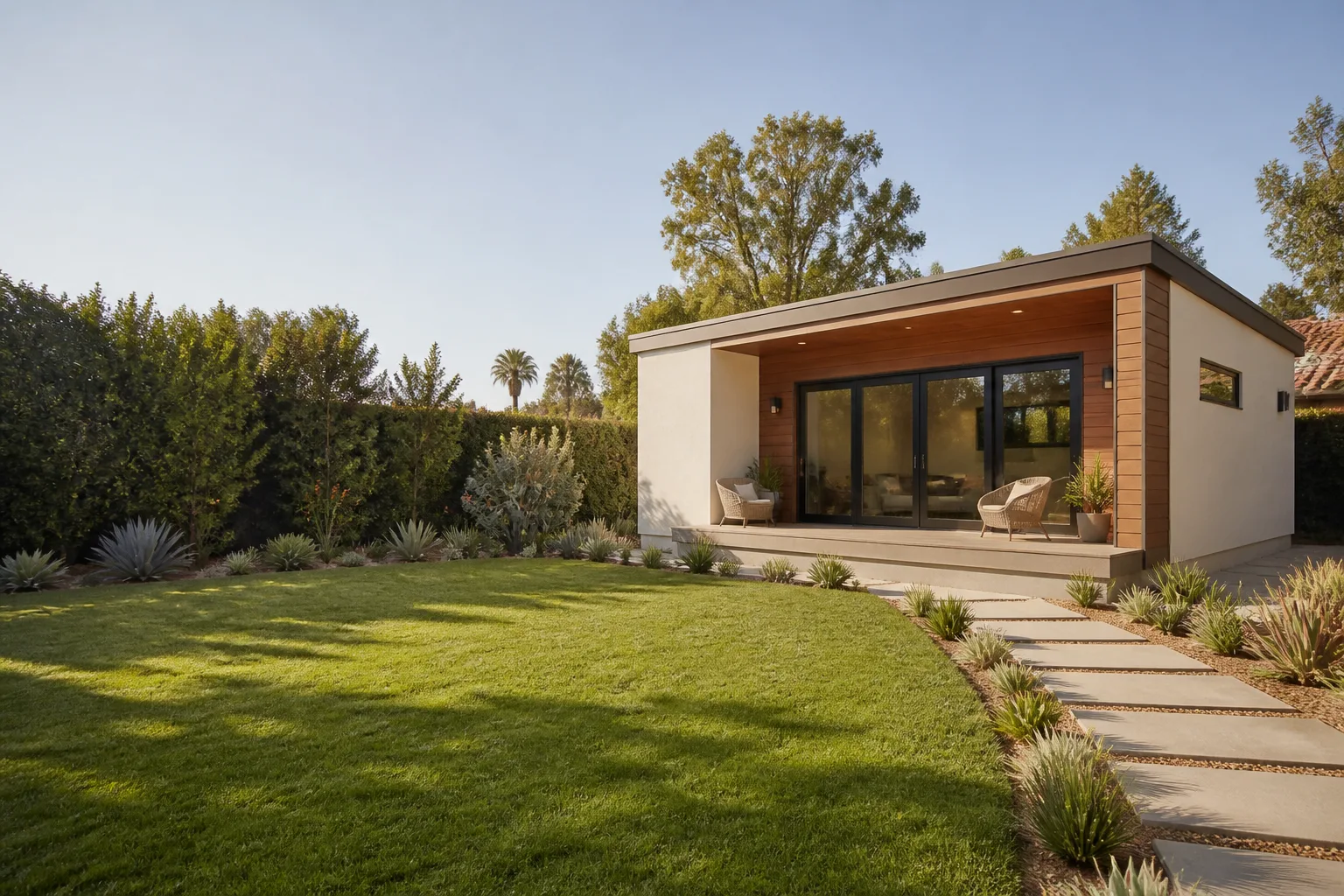
DIY ADU work in Los Angeles is legal in clearly defined zones, and homeowners who stay inside those zones can save $15,000 to $40,000 without risk. Step outside those zones, and the savings evaporate the moment code enforcement shows up, often replaced by costs that exceed the original budget. The deciding factor isn’t skill. It’s discipline. Stay on the right side of the legal line, write everything down, and know that the most expensive sentence in construction is “it’ll probably be fine.” If you’re weighing your options, get a clear picture of what a professional build would cost and where your time is best spent. Room Addition Contractor in Los Angeles services from Benson ADU Builders include free estimates at (903) 568-7222.
Written by Troy Eastman, Owner at Benson ADU Builders, serving Los Angeles since 2006.