Last updated October 9, 2026
DIY vs Professional ADU Builders: What’s Safe to Do Yourself
Here’s a number most YouTube tutorials skip: California law says you can pull your own owner-builder permit, build your own ADU, and save $40,000 to $80,000 in general contractor fees. What the video doesn’t show is the refinance application five years later, when a title company asks why a 500-square-foot dwelling was constructed without a licensed contractor’s stamp on the permit. In Los Angeles, where ADUs have become the single most popular way to add housing, the gap between what’s legally possible and what’s financially smart is wider than most homeowners realize. This guide walks through exactly which ADU tasks you can safely do yourself, which ones put your insurance and resale at risk, and how a hybrid approach can save you money without signing away your refinance options. For a deeper look at this decision, see our DIY vs Professional ADU: The Los Angeles Homeowner’s Decision Guide.
Quick Answer
You can legally act as your own general contractor on an ADU in California through an owner-builder permit, and you can safely DIY finish work like painting, trim, landscaping, and appliance installation regardless of who builds the shell. But structural framing, foundation work, electrical, plumbing, and HVAC should be handled by licensed professionals; doing them yourself risks failed inspections, voided insurance, refinance complications, and a resale restriction that follows owner-built structures for six years.
Table of Contents
- California’s Owner-Builder Rules: What the Permit Actually Allows
- ADU Tasks You Can Safely Do Yourself
- ADU Tasks You Should Never DIY, No Matter How Good the Tutorial Looks
- The Real Cost Savings of DIY: What You Actually Keep
- Owner-Builder as General Contractor: What It Really Means
- The Hybrid Approach: Professional Shell, DIY Finish
- What Building an ADU in Los Angeles Actually Looks Like
- Common Mistakes to Avoid
- When to Call a Professional
- Frequently Asked Questions
- The Bottom Line
California’s Owner-Builder Rules: What the Permit Actually Allows
California Business and Professions Code Section 7044 lets a homeowner pull a building permit for their own primary residence without holding a contractor’s license. You sign an affidavit called the Owner-Builder Verification form, which states you’re building for your own use and not for sale. That affidavit is where most DIY coverage stops, but it’s really where the story starts. The moment you sign it, you accept personal liability for everything on that job site: worker injuries, code violations, structural defects, and any future claim against the work. There’s no workers’ compensation policy covering a subcontractor who falls off your roof; that falls on your homeowners insurance, and most policies have exclusions for unlicensed work on owner-builder projects.
The second thing the affidavit triggers is a resale restriction. Under California law, an owner-built structure cannot be sold, leased, or offered for sale within six years of the certificate of occupancy, unless the buyer signs a specific disclosure acknowledging the structure was owner-built. That disclosure requirement doesn’t vanish after six years either; it stays with the property record permanently. When you refinance, title companies in Los Angeles routinely flag owner-built ADUs for additional underwriting review. Some lenders will still lend, but the appraisal often discounts the ADU’s value because there’s no licensed contractor’s warranty behind the work. That’s a real cost you’re absorbing, even if the paperwork feels far away on permit day.
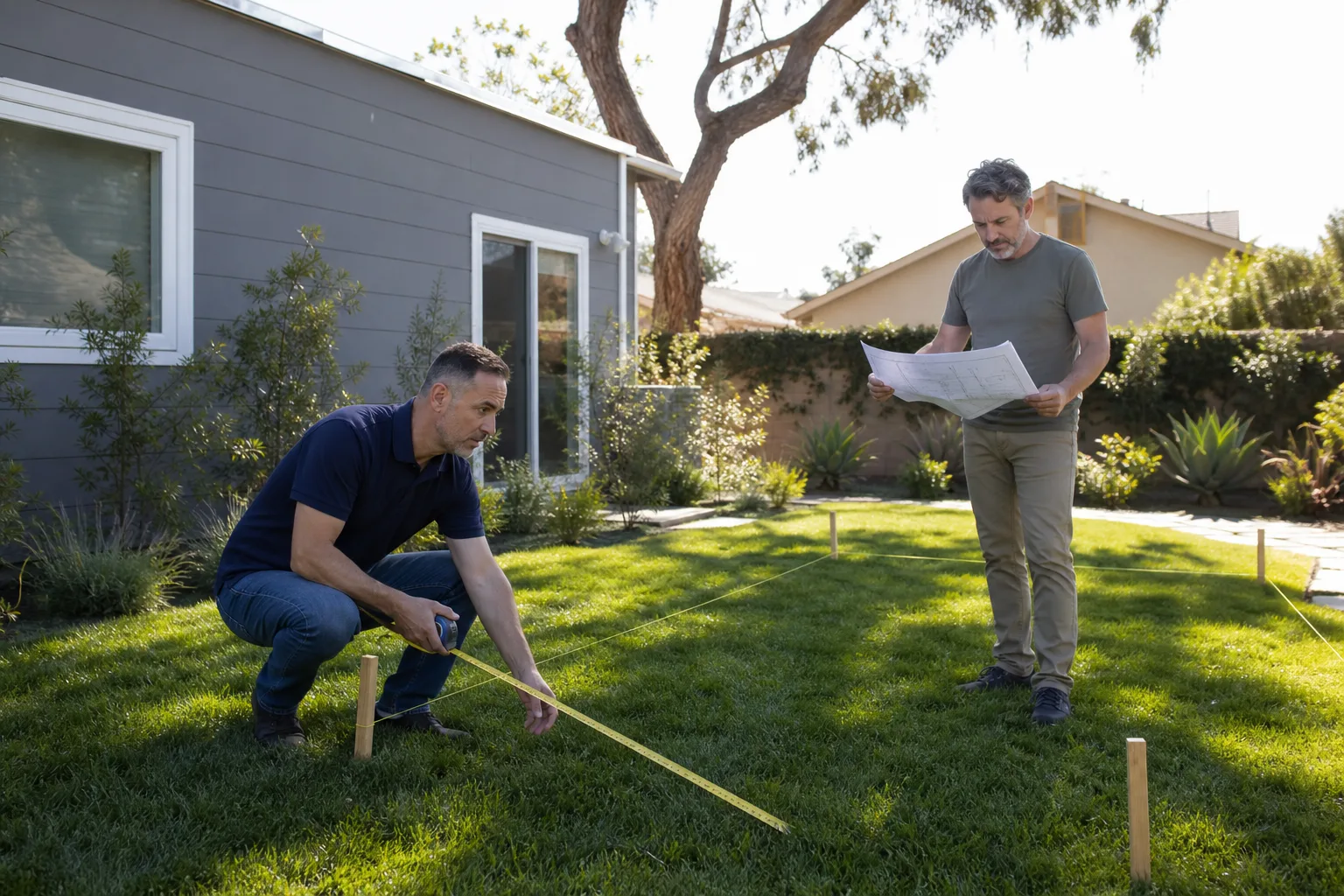
In Los Angeles specifically, ADU permits go through the Department of Building and Safety, and the plan check process doesn’t care who’s listed as the builder. It cares about code compliance. You’ll still need structural calculations, Title 24 energy reports, and site plans drawn to the city’s standards. What changes with an owner-builder permit is who’s responsible when the inspector finds a problem on the second rough inspection: you are the one who has to fix it, schedule the reinspection, pay the reinspection fee, and keep the project on the city’s timeline. A licensed contractor does that as part of the job; a DIY owner does it on nights and weekends while still working their day job.
The Affidavit You’re Actually Signing
When you pull an owner-builder permit in Los Angeles, you sign a statement acknowledging four things: you’re building on property you own and occupy, you’re doing the work yourself or hiring licensed subcontractors you directly supervise, you accept full responsibility for the work, and you understand that you cannot sell the structure within six years without special disclosure. That last clause is the one most homeowners only hear about when they’re sitting in escrow trying to sell a house with a four-year-old ADU and a buyer who wants a contractor’s warranty. No warranty exists; the buyer’s agent knows it; the price drops.
ADU Tasks You Can Safely Do Yourself
Let’s be clear-eyed about where DIY actually works. These are the tasks that don’t require a license in California, don’t touch structural or life-safety systems, and genuinely save money because they’re labor-heavy but skill-light. If you’re building with a professional contractor, you can often negotiate to take over these items after the shell is complete and inspections have passed.
Interior Finish Work
Painting, baseboards, door casing, window trim, and cabinet hardware are all fair game. None of these require a permit. None of them affect the structural integrity of the building. A typical 500-square-foot ADU in Los Angeles needs about three to five gallons of interior paint, 300 linear feet of baseboard, and a weekend of work. Contractors in LA charge $4,500 to $8,000 for interior painting of an ADU; doing it yourself costs about $600 in materials. That’s real money staying in your pocket. The key isn’t skill; it’s patience. Masking tape, drop cloths, a good brush, and two coats. It’s the same work a painter does, just slower.
Exterior Landscaping and Hardscape Around the Unit
Once the ADU is built, the area around it is yours. Planting, irrigation lines (low-voltage and drip only), pavers, gravel paths, and fencing don’t require building permits in most Los Angeles residential zones. Full irrigation systems with backflow preventers do require a plumbing permit, but simple drip lines staked to the surface don’t. One caveat: Los Angeles has specific front-yard and parkway landscaping ordinances, and ADUs often trigger a landscape review if the unit adds more than 500 square feet of new impermeable surface. If your ADU has a landscape plan attached to the permit, build it exactly as drawn. Deviations get flagged on final inspection.
Appliance Installation
Installing a refrigerator, washer, dryer, and freestanding range doesn’t require a licensed contractor in California. These plug into existing outlets and connections that were already inspected during the ADU’s rough and final electrical and plumbing inspections. The exception is a gas range: connecting a gas appliance line requires either a licensed plumber or a homeowner doing it under an owner-builder permit with a passed inspection. In Los Angeles, gas lines are inspected by the Department of Building and Safety; unpermitted gas work is a red-tag waiting to happen and a genuine safety hazard.
Finish Carpentry That Doesn’t Touch Structure
Floating shelves, closet organizers, window screens, and decorative beams are all DIY territory. The rule we’ve used for years: if it’s decorative and it can come off without affecting the building’s function, you can do it. The moment you’re cutting into a wall to move a stud, reroute a wire, or change a header, you’re in permit-and-license territory.
ADU Tasks You Should Never DIY, No Matter How Good the Tutorial Looks
This is where the YouTube confidence gap gets expensive. Every one of these items requires a licensed professional under California law, and every one of them carries consequences far beyond a failed inspection if something goes wrong.
- Foundation and slab work. Los Angeles sits in seismic zone 4. ADU foundations here are engineered for specific soil conditions near the San Andreas and Puente Hills fault systems. A rebar layout that’s off by three inches or concrete that cures too fast in summer heat fails the structural inspection, and the fix means demolition, not patching. Licensed foundation contractors pull their own permits and carry liability insurance for the work; you don’t.
- Structural framing. Framing an ADU means cutting, notching, and connecting lumber or steel in a way that holds up a roof, resists seismic forces, and passes a nailing inspection the city takes seriously. It also involves high-altitude work on ladders and scaffolding, where one fall is a hospital bill and a workers’ comp claim that your homeowners policy may not cover on an owner-builder site.
- Electrical panels, wiring, and service upgrades. California law requires a licensed electrician for any electrical work beyond changing a lightbulb or a switch plate. An ADU service upgrade often means running a new subpanel from the main house, which in many Los Angeles neighborhoods built in the 1920s and 1930s means replacing the entire main panel to handle the added load. Unlicensed electrical work is the number one cause of ADU insurance denials we see, and it’s the easiest thing for an inspector to spot.
- Plumbing and gas lines. Any plumbing beyond replacing a faucet washer requires a licensed plumber. ADU plumbing includes new waste lines, vent stacks, water supply runs, and possibly a new sewer lateral. In Los Angeles, older neighborhoods like West Adams and Jefferson Park often have clay sewer pipes from the 1950s; ADU construction regularly requires a sewer line inspection and replacement that costs $8,000 to $15,000 on its own. Unlicensed plumbing leaks are slow, invisible, and they rot the framing from the inside.
- HVAC and mini-split installation. Installing a mini-split unit requires handling refrigerant under EPA Section 608 certification; hooking it up to the electrical panel requires the electrician. A licensed HVAC contractor also sizes the unit correctly for a Los Angeles summer, when a 500-square-foot ADU without proper insulation can hit 95 degrees indoors by 3 p.m. Undersized units fail; oversized units short-cycle and die early.
- Roofing and waterproofing. ADU roofs in Los Angeles have to meet Title 24 cool roof standards, which means specific materials and installation methods. Any roof leak from DIY work voids your homeowners coverage for water damage, because the insurer will classify it as faulty workmanship. Roof work also means working at height, which is the single most dangerous category of residential construction work.
The Insurance and Permit Void You Create
When unlicensed work is discovered during an inspection, the inspector doesn’t just fail you. The city flags the permit, which stops all related inspections until a licensed contractor corrects the work and files amended plans. Your homeowners insurance policy almost certainly excludes damage caused by unlicensed work. That means a slow leak from a DIY plumbing joint that ruins your ADU’s subfloor is a claim your insurer denies, and the repair cost is entirely yours. In our experience in Los Angeles, the bill to fix unlicensed work before a sale closes usually runs 1.5 to 2 times what it would have cost to hire the licensed contractor in the first place.
The Real Cost Savings of DIY: What You Actually Keep
For a 500-square-foot ADU in Los Angeles, a typical site-built project with a licensed general contractor runs $200,000 to $300,000, or roughly $400 to $600 per square foot. Prefab ADUs from brands like Boxabl, Plant Prefab, and others usually land in the $150,000 to $275,000 range from permit to occupancy, depending on site conditions and finish level. The general contractor’s fee inside those numbers is typically 15% to 20% of the project cost, which on a $250,000 project is $37,500 to $50,000. That’s the number DIY owners are chasing.
Now let’s break down what you can actually keep. On a 500-square-foot, one-bedroom ADU:
- Interior painting: $4,500 to $8,000 professional; $500 to $800 DIY. You keep $3,700 to $7,200.
- Baseboards and trim: $1,500 to $3,000 professional; $200 to $400 DIY. You keep $1,100 to $2,600.
- Closet systems and shelving: $800 to $1,500 professional; $150 to $300 DIY. You keep $500 to $1,200.
- Landscaping around the unit (basic buffer plantings and path): $3,000 to $6,000 professional; $600 to $1,200 DIY. You keep $1,800 to $4,800.
- Appliance installation (freestanding, electric only): $300 to $600 professional; $0 DIY. You keep $300 to $600.
- Interior door hardware and bathroom accessories: $400 to $800 professional; $100 to $200 DIY. You keep $200 to $600.
If you do all of that yourself, you’re saving roughly $7,600 to $17,000 on a $250,000 project. That’s meaningful money, but it’s not $50,000. The difference is the contractor’s fee pays for structural framing, foundation engineering, electrical, plumbing, HVAC, roofing, permit management, scheduling, and the warranty. The DIY-able finish items at the end are the cheapest labor on the job, which is exactly why contractors are usually fine with you taking them over. They were never making much money on painting anyway.
Where DIY owners go wrong is trying to save the $50,000 by general-contracting the whole thing themselves, then discovering that the structural, electrical, and plumbing work still has to be hired out at the same market rates. You become an unpaid project manager with full liability and no volume discount. In Los Angeles, where good subs are booked months out and will prioritize general contractors who give them repeat work, an owner-builder’s timeline often runs six to twelve months longer than a contractor’s. That delay has a cost: every month your ADU isn’t rented is $1,800 to $2,500 in Los Angeles rental income you’re not collecting.
Owner-Builder as General Contractor: What It Really Means
When you pull an owner-builder permit, you are the general contractor. You’re not just picking paint colors; you’re hiring and firing every subcontractor, scheduling every inspection, ordering every material, and solving every problem. In practice on a 500-square-foot ADU in Los Angeles, that means managing about 15 to 20 separate trade visits: demolition, excavation, foundation, framing, roofing, rough electrical, rough plumbing, HVAC, drywall, stucco or siding, finish electrical, finish plumbing, flooring, painting, and final trim. Each one needs a licensed subcontractor if you’re not doing it yourself, which on an owner-builder ADU means you are doing exactly none of it under your own license, because you don’t have one.
The scheduling is where most owner-builders break. A typical framing crew will give you a two-week window and show up on day 11. Your electrician won’t come until the framing passes inspection. Your inspector won’t come until you call, and in Los Angeles the Department of Building and Safety runs on a first-come, first-served reinspection schedule that can take a week or more per attempt. One failed inspection resets the whole chain. A licensed general contractor absorbs that friction because they have standing relationships with subs who know their scheduling style, and they have the authority to hold a sub accountable for a missed date. An owner-builder is a one-project client; you’re the last priority on a sub’s calendar when a bigger builder calls with an emergency.
Then there’s compliance management. California’s 2023 energy code, Title 24 Part 6, requires HERS testing, blower door tests, and specific insulation and window ratings for ADUs. The city requires erosion control during construction, job site signage, and possibly a haul route permit if you’re in a construction-impacted area. Missing any of these means a stop-work order, which means your subs scatter to other jobs while you sort it out. Contractors manage this as a fixed cost of doing business; owner-builders learn it by failing and paying for the failure.
None of this means owner-builder is impossible. It means it’s a second job with a steep learning curve, and in Los Angeles, where the ADU boom has kept every inspector and every licensed sub busy for years, the learning curve is steeper than in a slower market.
The Hybrid Approach: Professional Shell, DIY Finish
Here’s the approach most homeowners land on after talking it through, and it’s the one we’ve seen work best in Los Angeles. Hire a licensed contractor for everything from demolition through the final structural and systems inspections: foundation, framing, electrical, plumbing, HVAC, roofing, drywall, stucco, and weatherproofing. Get the certificate of occupancy. Then take over the finish items yourself: painting, trim, closet systems, appliance installation, landscaping, bathroom hardware, and any other cosmetic work.
This works because the contractor’s work ends at a clear, verifiable point: the city has signed off on every required inspection and issued occupancy. The liability for the structural and systems work sits with the licensed contractor and their insurance. The finish work you do afterward doesn’t affect the permit record, the occupancy certificate, or the structural warranty. If you sell in three years, the ADU was built by a licensed contractor; the fact that you painted the walls yourself is irrelevant to a title company. You keep the refinance flexibility because the certificate of occupancy shows licensed work front to back on every system that matters.
The key is agreeing on scope before the contract is signed. Not every contractor will let you hold back finish work. Some build it into their margin and won’t separate it. Others, including us, are happy to write a contract that stops at drywall, paint-ready, with the paint and trim clearly excluded and the contract price reduced accordingly. Get that in writing. A verbal agreement to “let you paint it yourself” means nothing when the contract says “interior paint included” and the contractor’s painter shows up on day one. The split needs to be a line item, not a handshake.
One more thing to keep in mind: warranty boundaries. If the contractor’s 365-day workmanship warranty covers the work they performed, and you paint over their drywall, a drywall crack is still their issue; the chipped paint from your ladder is yours. That’s a clean split if the scope was written properly. It gets messy when the line between their work and yours wasn’t drawn in the contract. Ours is drawn in writing, line by line, before the first shovel turns.
What Building an ADU in Los Angeles Actually Looks Like
Los Angeles is not one permitting experience; it’s dozens, depending on whether your property falls under the city’s authority or one of the independent jurisdictions embedded within it. But most ADU construction within the city of Los Angeles runs through the Department of Building and Safety under the state’s ADU mandates, which have stripped away local discretion on things like parking requirements and minimum lot size. Since the state law changed in 2020, LA has consistently issued more ADU permits than any other city in California, with most of them concentrated in the San Fernando Valley and South LA, where lots are larger and garages are plentiful.
Garage conversions are the most common ADU type in Los Angeles, and they carry their own DIY trap: the existing structure was usually built in the 1950s or 1960s, often unpermitted, often on a slab that was never engineered for a dwelling, and often with electrical service that can’t support a second housing unit. Converting a garage without first checking whether the existing slab, footings, and roof structure can legally be reused under current code is the most common reason ADU projects in LA stall or die at plan check. A licensed ADU contractor starts with an as-built assessment; a DIY owner starts by measuring the garage and assuming it’s fine. In Los Angeles, where thousands of garages built between 1945 and 1970 still stand on unreinforced slabs, the assumption is expensive.
The city also sits in a high-seismic zone, which means even a detached ADU that’s under 500 square feet needs structural engineering and a foundation designed for lateral loads. The state’s ADU handbook is clear that a standard plan set from a permit service company must be adapted by a licensed engineer to the specific site. Soil conditions vary block by block: one stretch of the Valley sits on stable alluvial soil; another pocket near the Hollywood fault line has expansive clay that moves with wet winters and dry summers. A foundation designed for one will crack under the other. This is not knowledge that comes from a weekend of research; it comes from drilling holes in your specific lot and testing the soil. Licensed contractors in Los Angeles do this as routine; owner-builders often skip it and discover the error during the first rainy season or the first earthquake drill.
Common Mistakes to Avoid
- Signing the owner-builder affidavit without reading the six-year resale clause. In Los Angeles, where homeowners refinance to pull equity and buy rental properties, an owner-built ADU can stall a refinance for weeks while the lender’s underwriting team decides whether the structure is an asset or a liability.
- Doing electrical work “just this once” because the panel is in the garage and it seems simple. Unlicensed electrical work on an ADU invalidates the permit, voids the insurance coverage on the entire structure, and is the first thing a Los Angeles home inspector flags when you sell. Hire the electrician. It’s cheaper than the alternative.
- Assuming the garage slab is fine because it’s been there for 60 years. A slab that held cars for six decades was never engineered for the point loads of a dwelling, and Los Angeles building code doesn’t grandfather it. The plan check will catch this; better to catch it before you pay for plans.
- Skipping the soil test to save $1,500. Expansive clay is common in pockets across Los Angeles, and a foundation designed for one soil type will move differently on another. The engineer needs the soil data before drawing the foundation; skipping it means paying for a redesign later.
- Taking over the finish work without a written scope split. If the contract says “paint included” and you wanted to paint it yourself, you’re paying for the contractor’s painter or fighting about it mid-project. The split has to be in writing before the contract is signed.
- Hiring unlicensed subs on an owner-builder permit to save 20%. In Los Angeles, unlicensed subcontractors can’t pull permits, can’t pass inspections, and their work is automatically excluded from your homeowners coverage. An unlicensed “handyman” doing plumbing on your ADU is a five-figure liability waiting for a leak. The math never works.
- Assuming your homeowners insurance covers owner-builder construction. Most standard policies exclude or strictly limit coverage for owner-builder projects, especially once subcontractors without their own workers’ comp enter the picture. You need a builder’s risk policy during construction and a clear understanding of what your policy excludes. Most DIY owners discover the exclusion after the incident, which is the wrong time.
When to Call a Professional
If the ADU needs a new foundation, structural framing, a panel upgrade, new plumbing, a gas line, or any work at height, call a licensed contractor before you touch anything. If you’re not sure whether your garage conversion needs structural work, call before you start measuring. If you want the refinance flexibility and resale value that come with a licensed build, call before you pull any permit. In Los Angeles, the cost of the wrong DIY decision is usually higher than the contractor’s fee it was meant to avoid. ADU Builders like Benson ADU Builders offer free estimates in Los Angeles, and we’ll tell you honestly which parts you can safely handle yourself. Call (903) 568-7222 and ask for the written scope breakdown.
Frequently Asked Questions
Yes, California allows owner-builder permits for ADUs on a primary residence you own and occupy, but you’ll sign an affidavit accepting full personal liability for the work and agreeing to a six-year resale disclosure requirement on the structure. The permit process in Los Angeles still requires engineered plans, Title 24 energy compliance, and all the same inspections a licensed contractor’s project would face. If you’d rather have the permit pulled by a licensed contractor and avoid the owner-builder restrictions entirely, call (903) 568-7222 for a free estimate on your ADU scope.
A 500-square-foot site-built ADU in Los Angeles typically costs $200,000 to $300,000 from permit to occupancy, while prefab options built by brands like Boxabl, Plant Prefab, and Tuff Shed can land in the $150,000 to $275,000 range depending on site conditions and finish level. The general contractor’s fee inside those numbers is usually 15% to 20% of the total, which is what owner-builders are trying to avoid. Call (903) 568-7222 to get a written price for your specific site before you decide between DIY and professional.
You can do interior painting, trim work, closet systems, appliance installation (electric only), landscaping, and decorative carpentry without a license or a separate permit. You cannot legally do electrical work, plumbing, structural framing, foundation work, roofing, or HVAC installation yourself; California law requires licensed professionals for those trades, and unlicensed work voids insurance coverage, fails inspections, and creates resale problems. If you want the finish work and nothing else, tell your contractor upfront and get a written scope split so the contract reflects it.
It can. California law restricts the sale of owner-built structures for six years from the certificate of occupancy, and title companies in Los Angeles routinely ask for extra documentation on refinances for properties with owner-built ADUs, which can slow the loan or reduce the appraised value of the ADU. An ADU built by a licensed contractor carries a workmanship warranty and a clean permit record, both of which a title company sees as lower risk. That’s the refinance flexibility a DIY shell can cost you.
It means you pull the permit, hire every subcontractor directly, schedule every inspection, manage the city’s compliance requirements, and accept personal liability for everything that happens on site. On a 500-square-foot ADU in Los Angeles, that’s 15 to 20 separate trade visits and a project management workload that most homeowners underestimate by a factor of three. The money you save is the general contractor’s fee, but you’re doing the general contractor’s job without their subs’ relationships, and the timeline usually runs longer than a licensed contractor’s schedule.
Yes, and it’s the smartest split for most homeowners. Hire a licensed ADU contractor for everything from demolition through final inspections and the certificate of occupancy, then take over painting, trim, closets, appliance installation, and landscaping yourself. The structural and systems work carries the contractor’s license and warranty, and your DIY work doesn’t affect the permit record or the resale story. The catch is that the split has to be written into the contract before you sign; a verbal agreement won’t hold up when the painter shows up on schedule. Benson ADU Builders writes the scope split into every contract, line by line, with a written price before work starts. Call (903) 568-7222 to see what that looks like for your project.
The Bottom Line
California law lets you build your own ADU, but the law is not on your side when things go wrong. Owner-builder permits come with a signed liability affidavit and a six-year resale restriction that title companies in Los Angeles notice, and the insurance coverage gaps around unlicensed work are wider than most homeowners realize. The DIY work that actually pays off is finish work: painting, trim, closets, appliances, landscaping. That’s $7,000 to $17,000 back in your pocket on a 500-square-foot unit. The work that doesn’t pay off is anything structural, electrical, plumbing, or roofing; those mistakes cost twice as much to fix as they would have cost to hire. The smart play in Los Angeles is a hybrid: hire a licensed contractor for the shell and the systems, do the cosmetics yourself, and get the split in writing before the first inspection. For DIY vs Professional Home Addition Contractor: What’s Safe to Do Yourself, the same principles apply. That gives you the savings without the liability, and the refinance flexibility without the owner-builder asterisk on your title.
If you’re weighing DIY against professional on a Los Angeles ADU, start with a written scope and a written price. Benson ADU Builders can walk you through the split that makes sense for your project, show you prefab options from brands like Boxabl, Plant Prefab, and Tuff Shed, and put every number in writing before you commit. We’re the ADU team behind ADU Builders in Los Angeles, and we also handle home additions and room additions if your project grows beyond the ADU itself. Call (903) 568-7222 for a free estimate, and ask about the 365-Day Done Right Promise that comes with every project.
Written by Troy Eastman, Owner at Benson ADU Builders, serving Los Angeles since 2006. Explore more guides & resources on ADU construction.