Last updated October 9, 2026
ADU Builders Warning Signs Every Homeowner Should Know
The contractor who hands you the fastest bid and the lowest number isn’t winning your business out of efficiency. He’s winning it because he hasn’t priced in the things that will become your change orders later. In Los Angeles, where an ADU can run anywhere from $180,000 for a compact prefab unit to $450,000 or more for a custom two-bedroom build, that initial number is more than a starting point. For a detailed look at what drives these numbers, see our ADU Cost Breakdown: The Los Angeles Homeowner’s Reference for 2026. It’s a personality test. This guide walks through the red flags that separate builders who plan from builders who wing it, and we’ll cover the specific procedural shortcuts that reveal how a contractor thinks about your money when no one is watching. By the time you finish, you’ll know exactly which questions to ask before signing anything.
Quick Answer
The biggest ADU builder warning signs are procedural, not personal: a contractor who won’t put a full scope and price in writing before design begins, can’t name his licensed subcontractors, recommends a specific prefab product before walking your lot, or offers a vague verbal warranty instead of a written one. In Los Angeles, you can verify a contractor’s license through the CSLB in under three minutes, and a legitimate 365-day workmanship warranty should always specify exactly what’s covered, for how long, and what happens if a repair fails. Any builder who resists these checks is telling you something about how the project will actually go.
Table of Contents
- The Verbal Estimate Trap: Why “Ballpark” Is a Red Flag
- The 3-Minute CSLB License Check Every LA Homeowner Should Run
- The Subcontractor Transparency Test: Ask Who Touches Your Project
- The Prefab Upsell Without a Site Analysis: A Warning Sign to Take Seriously
- What a Legitimate 365-Day Warranty Looks Like in Writing
- Change Orders: The Line Between Normal and Manipulative
- Payment Schedules That Signal Trouble
- Communication Patterns Good Builders Never Use
The Verbal Estimate Trap: Why “Ballpark” Is a Red Flag
Here’s how it typically goes in Los Angeles. A contractor walks your property in Silver Lake or Van Nuys, nods at your backyard, and says something like, “For a unit this size, you’re probably looking at $210,000 to $240,000, but we’ll nail it down once we get into design.” That sounds reasonable. It is not reasonable. It’s a structural incentive to change-order you later.
When an ADU contractor refuses to commit a full scope and price to paper before starting design work, he has created a situation where every subsequent conversation about cost is a negotiation instead of a confirmation. The initial number was low enough to get you emotionally invested. By the time the real number arrives, you’ve spent weeks or months in design, you’ve told your family about the rental income, and you’re psychologically committed. Walking away feels like losing something you already own.
Here’s what a written price before design actually looks like. It includes the square footage, the foundation type, the number of windows and their quality tier, the electrical panel upgrade if needed, the sewer line connection, the roofing material, the interior finishes, and a line-item breakdown for each. It specifies what’s included and, just as importantly, what’s explicitly excluded. If a contractor can’t produce that document, he either doesn’t know his own costs or he knows exactly how to hide them.
In our experience building ADUs across Los Angeles through our ADU Builders services, the contractors who resist written pricing fall into two camps: the inexperienced ones who genuinely don’t know what a project costs until they’re halfway through it, and the experienced ones who know precisely what it costs and would rather you discover that number in installments. Neither is someone you want managing a six-figure project on your property.
The 3-Minute CSLB License Check Every LA Homeowner Should Run
California makes this easier than most people realize. The Contractors State License Board (CSLB) maintains a public database that takes under three minutes to search, and it catches the three most dangerous things a bad contractor can hide: an expired or nonexistent license, a bonding lapse, and unresolved complaints or legal actions.
Here’s the step-by-step:
- Go to the CSLB website and click “Check a License.” You’ll need either the contractor’s license number or their business name. A legitimate Los Angeles ADU builder will print this number on their business card, their website, and their estimate without being asked.
- Verify the license classification. In California, ADU construction requires a General Building Contractor (Class B) license at minimum. A Class C specialty license for, say, plumbing or electrical work alone does not authorize someone to build an entire dwelling unit. If the license classification doesn’t match the scope, that’s a stop sign.
- Check the bond status. California requires contractors to maintain a $25,000 contractor’s bond. If the bond shows as lapsed or cancelled, the contractor is technically not licensed to operate, and you lose a key financial protection if something goes wrong.
- Review the “Actions” or complaint history. The CSLB database shows disciplinary actions, arbitration awards, and unresolved complaints. A history of multiple unresolved complaints is different from the occasional dispute, and you’re allowed to ask about what you find.
One more Los Angeles-specific note: the city’s Department of Building and Safety enforces local ADU ordinances on top of state law, and a contractor who’s had repeated permit violations in LA will often show that pattern in their CSLB file. Search carefully. Three minutes now saves you from discovering a problem after your concrete is poured.
The Subcontractor Transparency Test: Ask Who Touches Your Project
This is one of the most revealing questions you can ask a potential ADU builder, and almost no homeowner thinks to ask it. The question is simple: “Who is your licensed plumber, who is your electrician, and who is your framing crew? Can I see their license numbers?”
A trustworthy builder answers immediately. Maybe he pulls up his phone and shows you the master plumber he’s used on the last eight projects in Pasadena and the Valley. Maybe he names the electrical contractor he’s worked with for a decade. He doesn’t treat this information as a trade secret, because it isn’t one. It’s a basic accountability mechanism.
A builder who stonewalls, hedges, or says “we’ll assign the right crew to your project when the time comes” is protecting margins, not trade secrets. Here’s what’s usually happening: he’s planning to shop the work to the lowest bidder once your project starts, which means the plumber and electrician on your job have no relationship with the builder and no incentive to produce quality work for you. They’re running through as many jobs as possible at the lowest possible labor cost.
This matters in Los Angeles specifically because the ADU boom has created intense competition for licensed trades. A builder with established subcontractor relationships can sequence your project properly: foundation, framing, rough plumbing and electrical, inspection, drywall, finishes. A builder who’s cold-calling subs from a job board is the one whose project stalls for three weeks while he finds an electrician who’ll take the job. Ask the question. The answer will tell you more than any marketing brochure ever will.
The Prefab Upsell Without a Site Analysis: A Warning Sign to Take Seriously
Prefab ADUs are genuinely excellent products. Companies like Dvele and Plant Prefab build panelized and modular units in controlled factory conditions, which means tighter tolerances, less construction waste, and faster on-site assembly than traditional site-built construction. We build with these brands because they solve real problems: weather delays, labor shortages, quality inconsistency. But there’s a specific sales pattern that should make you pause.
Here’s the red flag: a contractor recommends a specific prefab brand, or prefab in general, before walking your lot and reviewing your soil conditions, utility access, and setback requirements. A Boxabl unit or a Mighty Buildings panelized system has specific foundation needs, specific delivery constraints, and specific site requirements. Recommending one before knowing whether your Los Angeles hillside lot can even accommodate the crane or the delivery truck is like a doctor prescribing medication before examining you.
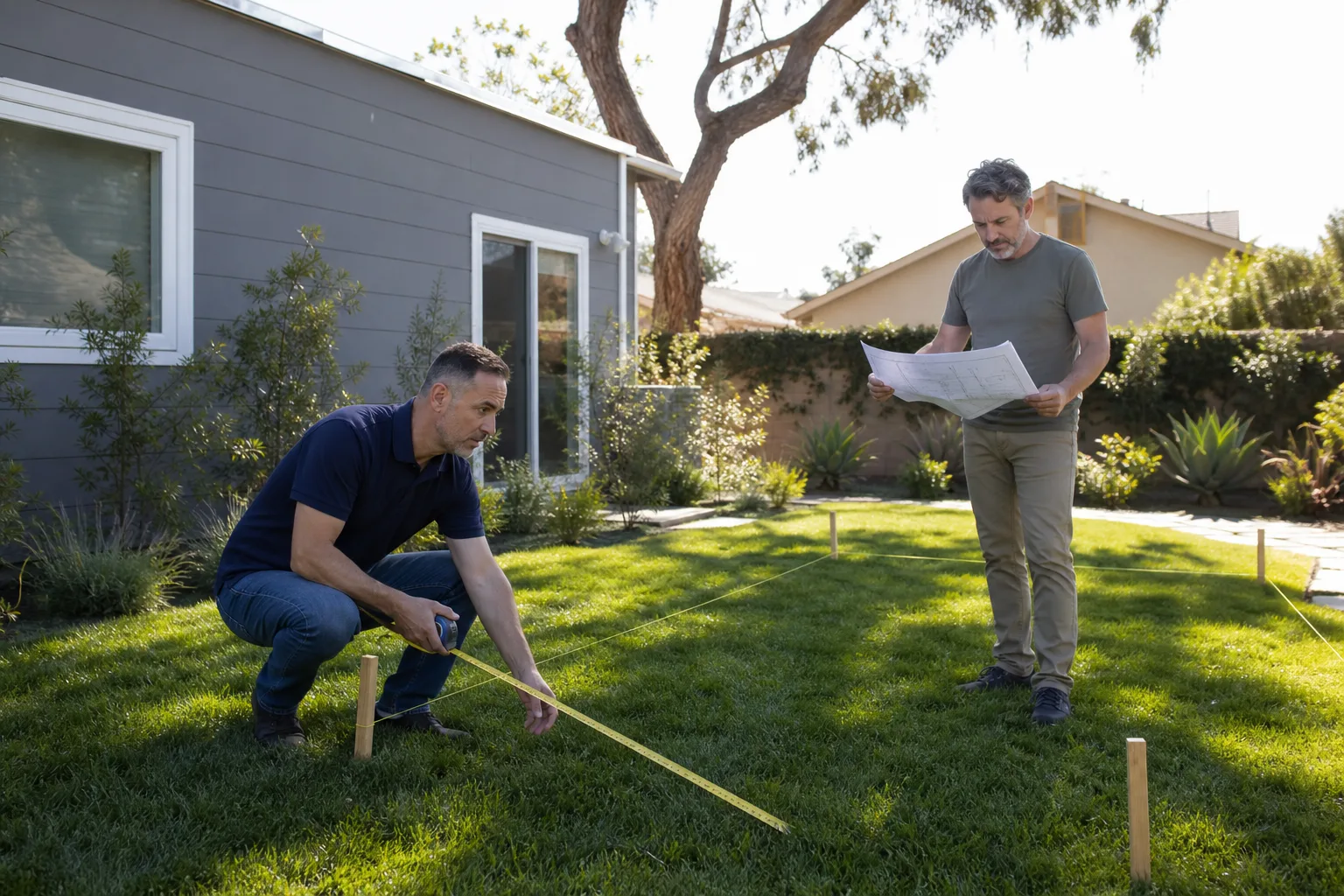
What a proper site analysis includes: a survey of the actual lot dimensions and slope, a geotechnical report or at minimum a soil percolation review, utility locates for water, sewer, gas, and electrical, a check of the city’s ADU ordinance requirements for setbacks and height limits, and an assessment of crane access and staging area. Only after all of that should a builder make a recommendation about which construction method, and which brand, fits your property.
When a contractor skips straight to “we can have your Dvele unit delivered in six months,” he’s recommending what’s easy to sell, not what fits your property. That’s not a product problem. That’s a process problem, and it’s a reliable predictor of how the rest of your project will go.
What a Legitimate 365-Day Warranty Looks Like in Writing
“We stand behind our work” is the most common sentence in the construction industry, and it means nothing. It’s not enforceable, it’s not specific, and when a crack shows up in your ADU’s stucco in month nine, the contractor who said it will suddenly be unavailable, forgetful, or defensive.
Here’s what a legitimate workmanship warranty looks like on paper. First, it names the contractor and the project address. Second, it specifies the coverage period in writing: 365 days from the date of substantial completion, or whatever the term is. Third, it lists what’s covered: workmanship defects, installation errors, materials that were installed incorrectly. Fourth, it lists what’s excluded: normal wear and tear, damage from misuse, acts of God. Fifth, and this is the part most homeowners miss, it says what happens if a covered repair fails during the warranty period.
That last provision is the difference between a real guarantee and a performative one. A builder with a real 365-Day warranty says: if we fix something and that fix fails within the year, we come back and fix it again, free. A builder with a vague verbal promise says: “I’ll take a look when I’m in the area.” The first sentence costs the builder money if he does bad work. The second costs him nothing. Which one do you think creates the incentive to do the job right the first time?
In Los Angeles, where an ADU is exposed to everything from coastal marine air in Santa Monica to extreme heat in the San Fernando Valley, a year is the minimum reasonable period to catch seasonal expansion, contraction, and settling issues. A contractor who won’t put that year in writing is telling you he doesn’t expect his work to last twelve months without problems.
Change Orders: The Line Between Normal and Manipulative
Change orders exist in every construction project. When you decide mid-project that you want a different tile pattern or an upgraded window package, that costs more money, and a written change order is the honest way to handle it. The red flag isn’t the existence of change orders. It’s the pattern of when and why they appear.
Let’s define the two types. Legitimate change orders come from you: “We decided we want the vaulted ceiling after all.” Manipulative change orders come from the builder: “We discovered your sewer line is too shallow, so we’ll need to add a lift pump for $8,000.” Wait, why wasn’t that discovered before the foundation was poured? Why wasn’t it in the written scope?
A builder who does proper site analysis, pulls initial utility maps, and reviews your city’s records catches most “discoveries” before construction starts. A builder who routinely “discovers” expensive problems mid-project is either incompetent at pre-construction due diligence or is deliberately low-balling the initial price to win the job and recouping margin through change orders. In Los Angeles, where many ADUs go into backyards with aging sewer laterals and outdated electrical panels, the difference between these two builders is worth tens of thousands of dollars.
The right question to ask any builder before signing: “Walk me through the last three projects where you issued change orders. What were they for, and when did they appear?” A builder who can answer that question honestly and specifically is one who tracks his own performance. A builder who waves it off with “every project has some surprises” is one who profits from those surprises being expensive.
Payment Schedules That Signal Trouble
The way a contractor structures his payment schedule is a roadmap of his cash-flow situation, and his cash-flow situation is directly relevant to your project’s risk. California law caps the down payment on home improvement contracts at 10% or $1,000, whichever is less. Anyone asking for more than that before work begins is breaking state law, and that alone should disqualify him.
But there’s a subtler red flag that’s just as important: front-loaded schedules. A legitimate ADU builder ties payments to completed work milestones. Something like 10% at contract signing, 20% at foundation completion, 25% at rough framing, 25% at rough mechanical inspection, 15% at final inspection, and 5% at punch-list completion. Each payment corresponds to verifiable progress you can see with your own eyes.
A contractor who wants 50% before the foundation is poured is using your money to fund his other projects. His schedule looks like this: 25% down, 25% at “mobilization,” 25% at “materials order,” and 25% at “substantial completion,” all of which may happen in the first month. If he walks off your job, you’ve paid for two-thirds of a project that’s one-tenth built.
Ask for the payment schedule in writing before you sign. If the milestones are vague, if the early percentages are high, or if the contractor gets defensive about the question, those are warning signs. In Los Angeles, where a typical ADU project runs four to eight months, a builder with a healthy business can afford to tie his revenue to your project’s actual progress.
Communication Patterns Good Builders Never Use
Most contractor red flags are procedural, but some are behavioral, and they show up in the first few conversations. Watch for these patterns, all of which we’ve seen play out across Los Angeles ADU projects:
- The disappearing bid. You ask for a written estimate, and two weeks later you’re still following up. If a contractor can’t produce a written price within a reasonable timeframe during the sales phase, imagine his responsiveness when your project is mid-construction.
- The shifting number without explanation. The estimate comes in at $220,000. You ask a clarifying question, and the revised estimate is $245,000. When you ask why, the answer is vague. A legitimate builder can explain exactly which line item changed and why.
- The voicemail loop. You call three times and get a recording every time. Some contractors are busy, yes. But a builder who takes your six-figure project’s money and then goes dark between milestones is a pattern, not a coincidence.
- The pressure close. “I can hold this price for 48 hours” or “I’ve got another client interested in this slot.” Artificial scarcity is a sales tactic borrowed from used-car lots, and it’s especially ridiculous in ADU construction, where your project is months from starting regardless. A builder who pressures you is a builder who doesn’t want you to get other bids.
- The missing license number. You ask for a CSLB license number, and the contractor doesn’t have it handy, or it’s not on his estimate, or he says he’ll email it later. In California, a licensed contractor is required to include his license number on all contracts and advertisements. If it’s missing, something is wrong.
None of these behaviors is dispositive on its own. But when you see two or three of them in the same contractor, you’re looking at a pattern, and the pattern says: this person does not respect your time, your money, or your project. Believe the pattern.
Common Mistakes to Avoid
- Choosing the lowest bid without comparing scopes. A $190,000 bid and a $240,000 bid are not bids for the same project if one includes a new electrical panel, sewer connection, and site drainage while the other doesn’t. In Los Angeles, scope omissions are the most common way low bidders win jobs they shouldn’t.
- Signing a contract without a written scope of work. A contract that says “build 800-square-foot ADU per plans” without specifying finish levels, appliance allowances, and material grades is not a contract. It’s a permission slip for upgrades and surprises.
- Skipping the CSLB check because the contractor seemed nice. Nice is not a license. Three minutes on the CSLB website is the cheapest insurance you’ll ever buy.
- Accepting a verbal warranty instead of a written one. If the warranty isn’t in writing with specific terms, it doesn’t exist. In month nine, your memory of a friendly conversation will not hold up in any dispute.
- Letting the contractor pull permits in his own name without verifying. Always confirm that permits are actually pulled and that inspections are actually passed before you release each payment milestone. In Los Angeles, an unpermitted ADU can make your property unsellable later.
- Paying too much up front. California law caps the down payment at 10% or $1,000, whichever is less. A contractor who asks for more is breaking the law in a way that predicts how he’ll behave for the next eight months.
- Ignoring the subcontractor question. Who actually builds your ADU matters more than who signs the contract. A builder who won’t name his licensed trades is hiding something.
When to Call a Professional
Some situations need a builder’s eye before you make any decisions. If your property has a steep grade or difficult soil, if your sewer lateral is old or your electrical panel is maxed out, if you’re in a Los Angeles hillside or coastal zone with special code requirements, or if you’ve gotten three bids with wildly different numbers and you can’t tell what’s included in each one, call someone who can walk the lot with you and explain what’s actually going on. The right conversation is less about selling you a unit and more about understanding your property, your timeline, and your budget. Benson ADU Builders offers free estimates in Los Angeles, and we’ll put the price in writing before you commit to anything. Call (903) 568-7222 and ask for the written scope and price. If a builder won’t give you that, you’ve learned everything you need to know.
Frequently Asked Questions
Go to the CSLB website, click “Check a License,” and search by license number or business name. Confirm the license is active, the classification is General Building Contractor (Class B), the bond is current, and there are no unresolved complaints or disciplinary actions. The whole check takes under three minutes and is free.
A prefab or panelized ADU in Los Angeles typically runs $180,000 to $320,000 depending on size, brand, and site conditions, while a custom site-built two-bedroom unit can run $350,000 to $450,000 or more. The final number depends heavily on your lot’s soil conditions, utility access, and whether your existing electrical panel needs an upgrade. A written scope and price before design starts is the only way to know which number applies to your property.
Ask for their CSLB license number and verify it. Ask for a written scope of work with line-item pricing before design begins. Ask who their licensed plumber, electrician, and framing crew are. Ask what their 365-day warranty covers in writing and what happens if a covered repair fails. Ask for their last three projects’ change order history. If the builder answers all of these clearly and specifically, you’re likely in good hands.
No. California law requires certain construction contracts and warranties to be in writing to be enforceable, and even where verbal agreements can theoretically bind, proving their terms later is extraordinarily difficult. A legitimate warranty specifies the covered period, the covered scope, the exclusions, and the remedy if a covered repair fails. “We stand behind our work” is a sentence, not a warranty.
Prefab and panelized ADUs from companies like Dvele, Plant Prefab, and Boxabl are manufactured in controlled factory conditions and assembled on-site, which typically means faster construction and tighter quality control. Site-built ADUs are framed and finished entirely on your property, which allows more customization but takes longer and is more exposed to weather and labor variability. The right choice depends on your lot conditions, your timeline, and your budget, and it should only be made after a full site analysis.
It depends on why the price changed. If you requested a change, a written change order is the honest mechanism. If the contractor “discovered” a problem that should have been caught during pre-construction due diligence, that’s either incompetence or deliberate low-balling, and it’s a red flag. A written scope of work with clear pricing before design starts is the strongest protection against mid-project price increases. Call (903) 568-7222 for an exact quote, and ask any builder you’re considering to put their number in writing.
The Bottom Line
The contractors you should avoid in Los Angeles aren’t usually obvious con artists. They’re builders who skip the boring work of site analysis, written pricing, and documented warranties because that work doesn’t win bids. But it’s exactly that unglamorous, procedural diligence that protects you from change orders, delays, and defective work. Verify the license. Demand the written scope. Ask about the subcontractors. Read the warranty language. And if a builder resists any of those requests, walk away. The best ADU builder for your project is the one who behaves before you sign exactly the way he should behave after.
Written by Troy Eastman, Owner at Benson ADU Builders, serving Los Angeles since 2006.