James Hardie Garage Conversion ADU: The Los Angeles Owner’s Guide
If you’re converting a garage into an ADU in Los Angeles and the exterior cladding or trim is failing, we stock and install James Hardie-compatible siding, trim, and weather-barrier components, with most conversions running $180,000 to $320,000 all-in depending on square footage, foundation work, and finish level. The cladding portion itself typically lands between $12,000 and $28,000 installed for a standard two-car garage footprint in LA. What usually brings owners to this page is a specific, visible problem: cracked HardiePlank boards near the bottom course, swollen trim around the garage door opening, or water staining where the old stucco met the slab. You’re not looking for a whole new house; you’re looking for the right part, matched to your existing James Hardie product line, priced honestly, and installed before the next rain hits.
We’re an independent contractor, not a James Hardie corporate entity. That matters because we can tell you when an aftermarket weather barrier makes more sense than an OEM accessory and when it doesn’t, without a sales quota attached to the answer.
Key Takeaways:
- James Hardie siding and trim on garage conversions fail first at grade contact, door openings, and improper flashing transitions.
- Most cladding repairs on a Los Angeles garage ADU run $1,800 to $6,500 when caught early; full re-cladding runs $12,000 to $28,000.
- HardiePlank lap siding is not the same as HardiePanel vertical siding; they are not interchangeable without re-framing nailing patterns.
- Our written price covers the part, labor, flashing, and paint-match on the repaired section before work begins.
Which James Hardie Models This Applies To
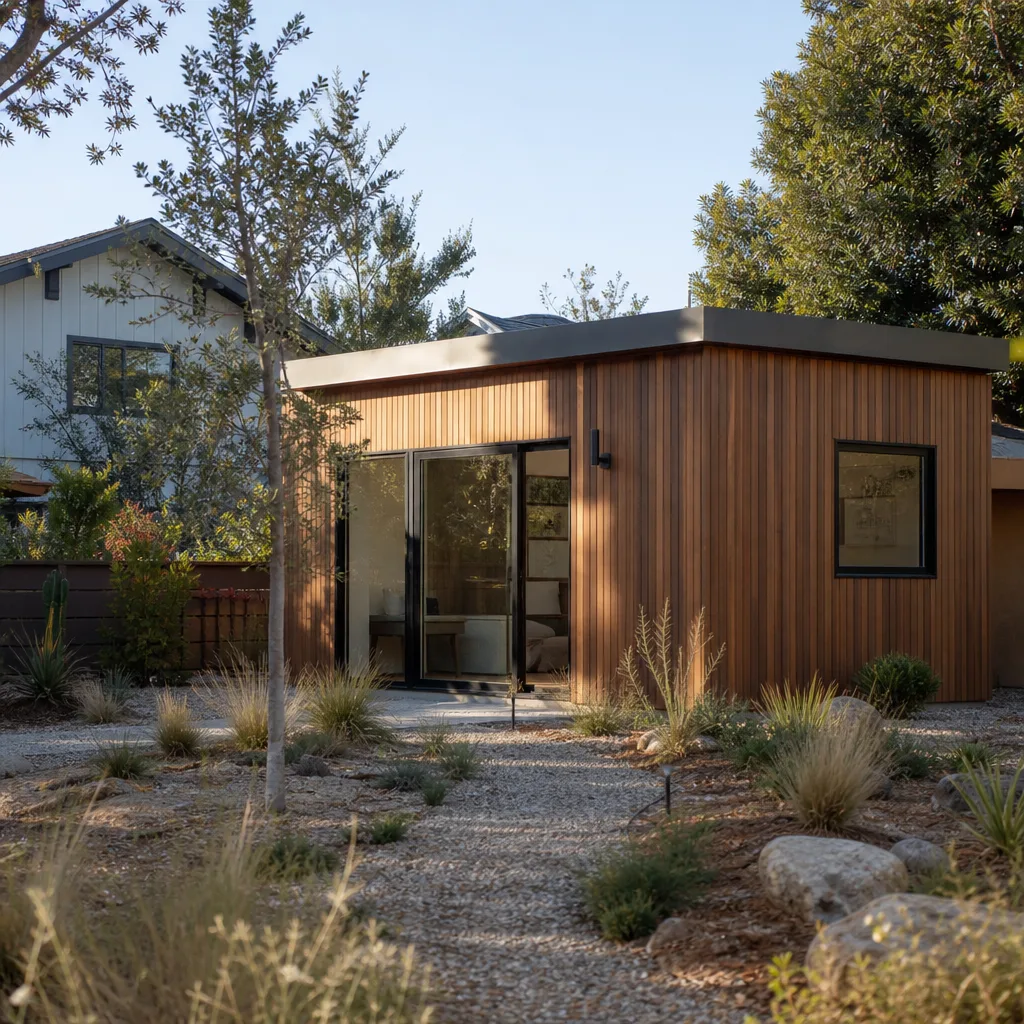
This page covers the three James Hardie product lines we most often spec on Los Angeles garage conversions: HardiePlank lap siding (the horizontal boards), HardiePanel vertical siding (the 4×8 or 4×10 sheets), and HardieTrim boards (the 3/4-inch thick trim used around windows, doors, and corners). Each line has its own fastener requirements and exposure ratings, and mixing lines without adjusting the nailing schedule is a common cause of premature cracking and voided product warranties.
How to identify what you have: HardiePlank boards are 5/16-inch thick and come in 12-foot lengths with a visible wood-grain or smooth face. HardiePanel sheets are 5/16-inch thick and ship in 4×8, 4×9, or 4×10 dimensions with a stucco-like texture. HardieTrim is noticeably thicker at 3/4 inch and ships in 16-foot lengths. If you’re unsure, take a photo of the back edge of a broken piece; the product code is stamped there, and we’ll match it from that. One compatibility gotcha worth knowing: HardieTrim board cannot be ripped down and used as a substitute for HardiePlank lap siding; the trim is a different fiber-cement density and will not lay flat if face-nailed as lap siding.
OEM versus aftermarket: for the cladding and trim themselves, we use genuine James Hardie product because the warranty math favors it. For the weather barrier behind the cladding, the flashing, and the sealants, we stock and use aftermarket equivalents from brands like Tyvek, ZIP System, and OSI, which frequently outperform the builder-grade accessories some box stores bundle with Hardie orders. James Hardie makes siding, not housewrap; pairing their board with a top-tier aftermarket barrier is the correct spec.
Signs Your James Hardie Garage Conversion ADU Is Failing
- Cracking at the bottom course near grade. Los Angeles soil expands and contracts with seasonal moisture, and HardiePlank installed too close to the ground wicks water and cracks under slight slab movement. The board should sit at least 6 inches above finished grade; anything less shortens its lifespan dramatically.
- Swelling or crumbling HardieTrim around the old garage door opening. When a garage door is converted to a wall, the trim at the former opening becomes a water entry point if the flashing wasn’t re-done. In LA’s winter rain pattern, this shows up within two to three seasons.
- Paint peeling in a horizontal line halfway up the wall. This is usually a failed butt joint where two HardiePlank courses meet. Water gets behind the joint, and the paint loses adhesion in a straight line that matches the board seam.
- Soft drywall or musty odor inside the ADU at the wall base. By the time fiber-cement cladding failure is visible from inside, the weather barrier behind it has been saturated for months. This is the stage where a simple board swap becomes a small remediation project.
- Gaps opening between corner trim and siding. Hardie boards expand and contract with temperature swings, and our 40-degree LA summer-to-winter differential is enough to open caulk joints over time. Re-caulking without addressing the underlying nail pattern is a temporary patch, not a fix.
Replacement Cost & What’s Included
For a Los Angeles garage conversion ADU, isolated James Hardie part replacement runs $1,800 to $6,500 depending on how many boards or trim pieces failed and whether we’re opening the wall to inspect the barrier. A full exterior re-cladding of a standard two-car garage ADU runs $12,000 to $28,000 installed. That range covers: removal and disposal of the existing cladding, inspection and repair of the weather barrier, new James Hardie product, flashing, sealants, and paint-match on all repaired sections. What moves the price is access (tight side setbacks add scaffolding days), the condition of the sheathing underneath, and whether the original install included proper head flashing above doors and windows. We price the job in writing before work starts, so the number you approve is the number you pay. No change orders, no discovered-this-once-we-opened-the-wall surprises. Troy Eastman grew up in the Palms neighborhood of Los Angeles, and he’s seen enough garage conversions to know exactly where water finds its way in before we ever open a wall. Every promise goes in writing before a single shovel turns.
DIY or Call Us?
You can safely check a few things yourself: measure the gap between your bottom course and the ground, look for visible cracks near door corners and butt joints, and check whether the caulk at trim intersections is pulling away. If you find a hairline crack in one board with no interior signs of water, a fiber-cement patch and paint is a legitimate DIY afternoon if you have experience working with silica-dust generating materials. What you should not do: cut or sand James Hardie board without a proper dust shroud and HEPA vacuum. Fiber cement silica dust is a genuine lung hazard, and the board’s weight makes solo removal on a ladder a bad idea. If the failure involves more than two boards or any sign of interior water intrusion, call us at (903) 568-7222, and we’ll tell you honestly whether it’s a patch job or a re-cladding before anyone schedules a visit.
FAQs
Properly installed James Hardie cladding on an LA garage conversion typically lasts 30 to 50 years, but the first failure point is almost always installation-related flashing, not the board itself. In our market, poorly flashed garage conversions show cladding problems within 3 to 7 years. Call (903) 568-7222 if you’re seeing early failure; it’s usually a finite fix, not a whole-wall replacement.
A single hairline crack with no water penetration behind it can be repaired with fiber-cement patching compound and repainted, and that repair will hold for years if the board is otherwise sound. If the crack runs through the full board thickness or you see staining below it, the board needs replacement. We’ll tell you which situation you have before quoting anything.
A single-board or trim replacement on a garage ADU takes one day including paint-match drying time. A full re-cladding takes 3 to 7 days depending on access, weather, and the condition of the sheathing we find underneath. Our written estimate includes the schedule before you approve the work.
We stock the most common HardiePlank colors, exposures, and HardieTrim profiles on our trucks, along with the flashing and sealant brands we standardize on. Less common profiles and colors are ordered per job from our LA supplier and typically arrive within 3 to 5 business days. If we don’t have it on the truck, we’ll tell you the lead time before you commit to anything.
If your James Hardie garage conversion ADU in Los Angeles is showing cracks, swelling, or water damage, call Benson ADU Builders at (903) 568-7222 for a free written estimate. We’ll match the part, quote the repair honestly, and put the number in writing before any work begins.
Written by Troy Eastman, Owner & Lead Builder, Benson ADU Builders at Benson ADU Builders, serving Los Angeles and nearby areas.