
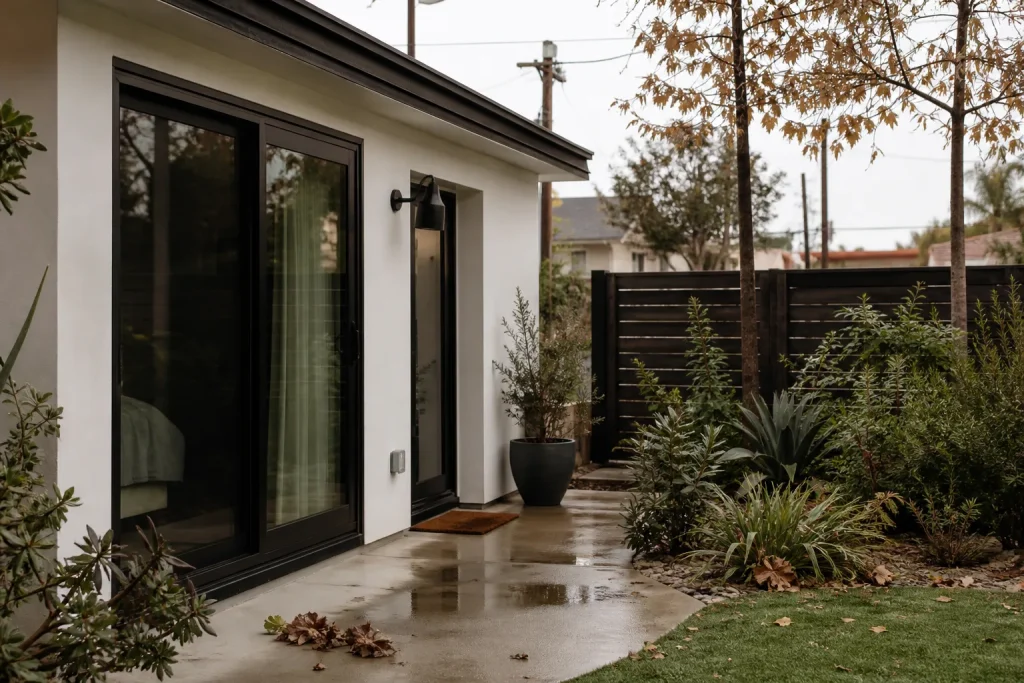
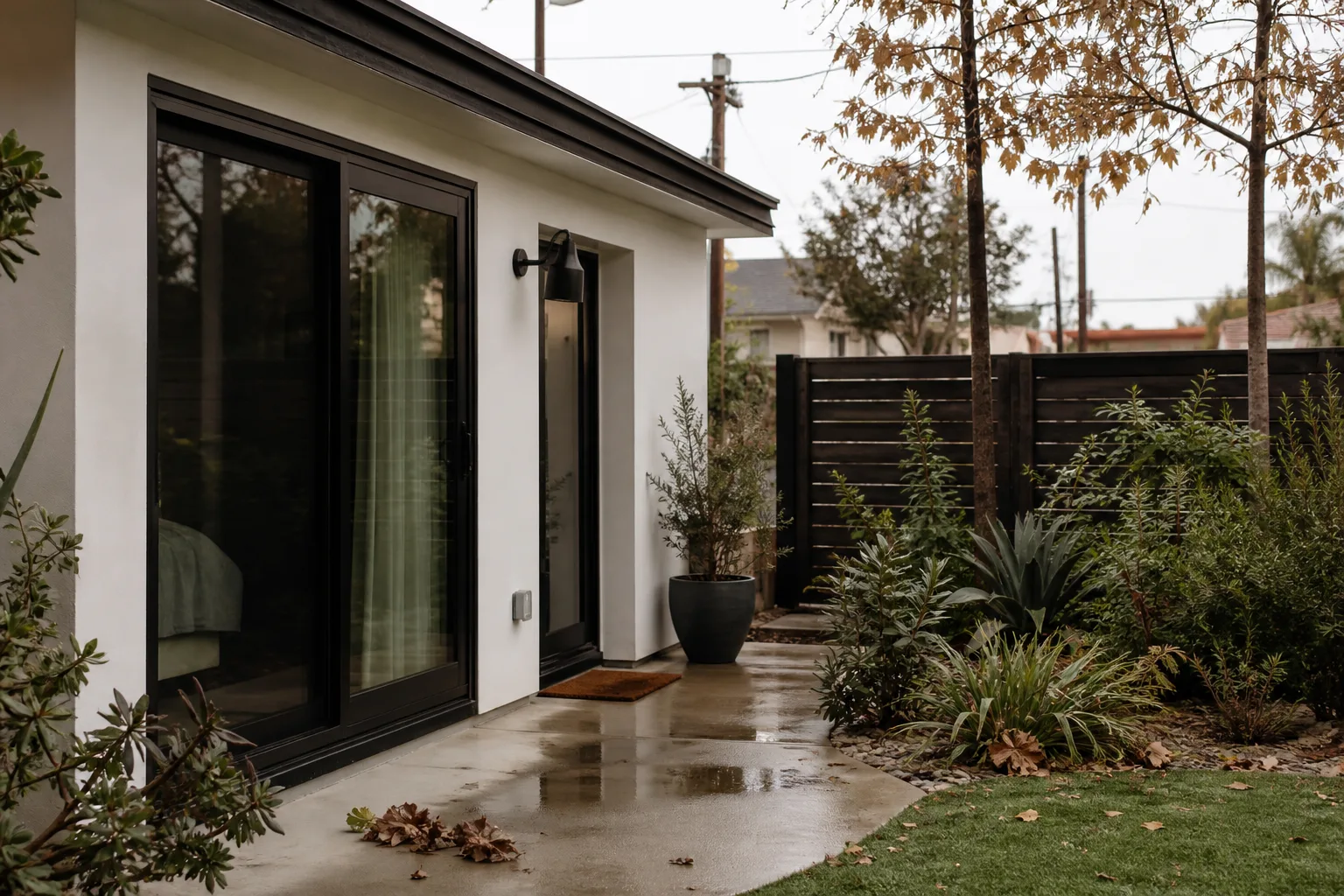
Preparing Your Home’s ADU for Winter in Los Angeles
Winter prep for a Los Angeles ADU is not about snow and ice. It’s about water. LA receives roughly 15 inches of rain per year, but it arrives in 10 to 15 intense, short-duration storms, not spread gently across the calendar. An ADU that sat bone-dry through nine months of clear skies can reveal a roof penetration leak, a saturated foundation, or a clogged drainage path the first week of November, right when every roofer and drainage contractor in the county is suddenly booked out six weeks. The good news is that a thorough rainy-season prep takes about two hours and typically costs under $500 in materials. If you would rather skip the ladder work and hand it to a crew that puts a written price in front of you, call (903) 225-2278 for a free estimate.
Key Takeaways
- LA winter damage is almost always water-related, and it shows up during the first two or three heavy storms.
- Inspect the roof, penetrations, drainage grading, mini-split system, weatherstripping, and insurance documentation before November.
- Most prep tasks cost under $500 in materials. Waiting until a leak appears usually costs several thousand.
- Document your ADU’s condition with photos before storm season so any insurance claim has a clean pre-storm baseline.
Why Los Angeles ADUs Fail in Winter (It’s Not the Cold)
The failure mode for a Los Angeles ADU in winter is almost never freezing temperatures. It is water moving where it should not move. Los Angeles sits on expansive clay soils in many neighborhoods, from the Valley floor up through the foothill communities. Those soils swell when saturated. A foundation that looked perfectly level in September can show a hairline crack or a shifted downspout by January, not because the structure failed, but because the ground underneath it changed shape.
We have walked ADU sites in Los Angeles where the owner spent three summers in the unit with zero problems, then called us after the first big atmospheric river. The issue in nearly every case was a penetration: a pipe boot, a vent flashing, a mini-split line set passing through an exterior wall. Small opening, slow leak, months of unnoticed moisture. By the time a stain shows on the ceiling drywall, the water has been working for weeks.
The other quiet winter killer is drainage. Los Angeles building codes require site grading that slopes away from the foundation, but soil settles. Landscaping changes. A neighbor’s new retaining wall redirects sheet flow across your yard. An ADU poured three years ago may no longer have positive drainage today. Checking it costs nothing. Fixing it early is a couple hundred dollars for a few bags of compacted fill. Fixing it late is a foundation repair conversation you do not want to have.
Roof and Penetration Inspection: What to Check on LA ADU Roof Types
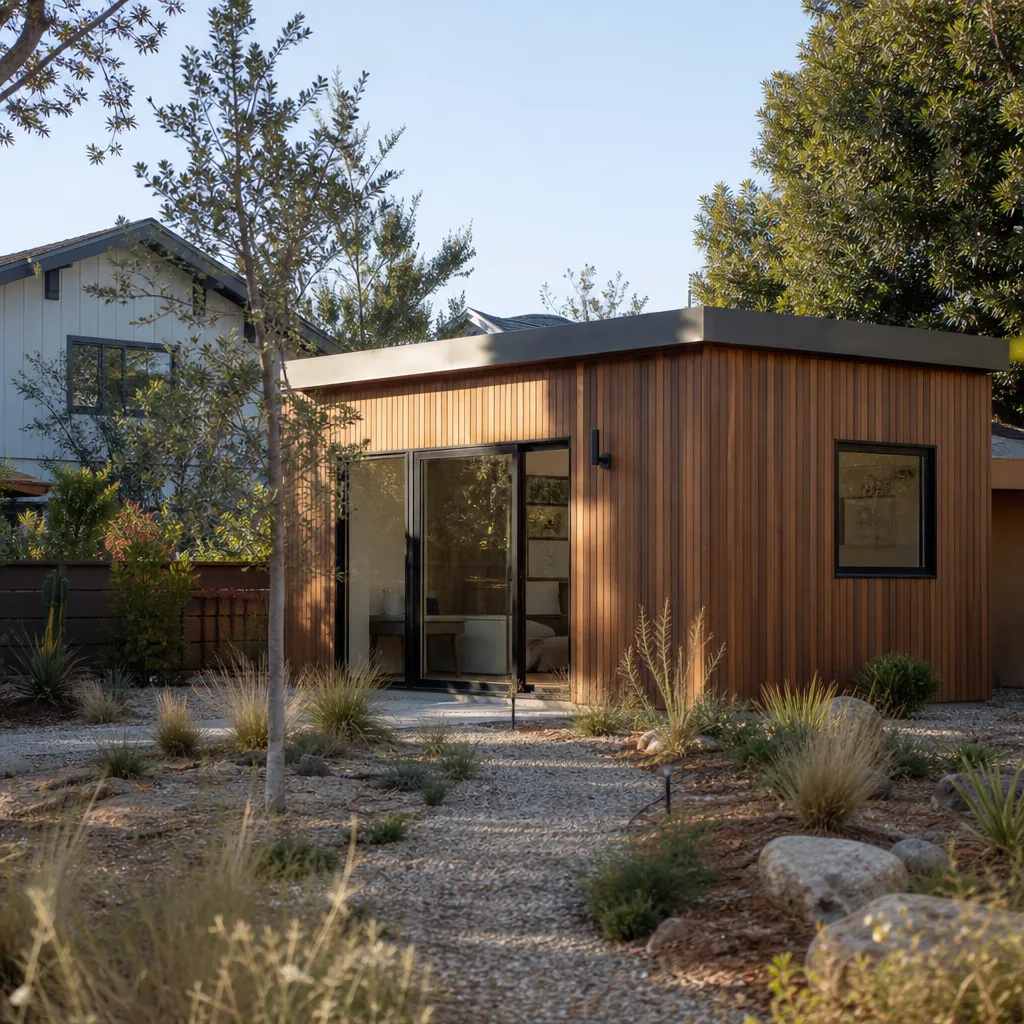
The roof is where winter prep starts. Most Los Angeles ADUs are built with one of three materials: a flat TPO membrane, standing seam metal, or a composition shingle roof. Each fails differently, so the inspection list changes.
Flat TPO roofs are common on modern prefab and site-built ADUs because they are energy-efficient and relatively inexpensive. TPO is welded at the seams, not glued, which is good. But the failure points are the penetrations: plumbing vents, exhaust fan caps, and the electrical conduit for the mini-split. Look for lifted or cracked flashing, peeling lap sealant, and any area where standing water pools more than 48 hours after rain. Ponding water is a red flag. It accelerates membrane degradation and eventually finds a seam.
Standing seam metal is popular on units from brands like Benson ADU Builders home builds with, and it sheds water well. But the screws that hold the ridge caps and edge trim can back out over repeated thermal expansion cycles. Run your eyes along the ridge line and the gable ends. Any missing or rusted fastener is a leak waiting for the first windy rain. Do not caulk over a missing screw. Replace the fastener and check the rubber washer.
Fiber-cement siding, like James Hardie, handles LA’s wet-dry cycles well, but it is only as good as the flashing at the bottom course and around window openings. If the bottom edge of the siding is within two inches of the ground, wicking is happening. Look for darkened lower panels, soft spots, or paint failure at the base. When you see that, call a pro. If the damage is just a small section of popped caulk around a window head, a tube of quality exterior sealant handles it in ten minutes.
When to call a roofer versus DIY-caulk it: if the issue is a visible crack in a pipe boot or a lifted shingle tab, caulk or replace the boot yourself. If you see daylight through a penetration, water staining on the underside of the roof sheathing, or moss growing on a flat membrane, call a licensed contractor. Those are structural issues, not maintenance items.
Drainage and Grading Audit: The $0 Check That Prevents $20,000 Repairs
This is the most skipped step in Los Angeles ADU winter prep, and it is the one that produces the most expensive failures. Walk around the ADU after the next dry spell and look at the ground. The soil should slope away from the structure in every direction for at least five feet. If you see any area where the ground is level with the foundation or, worse, sloping toward it, water is being delivered to your footing every time it rains.
Here is the quick audit:
- Wait until the ground is dry, then run a garden hose at a low flow near each corner of the ADU.
- Watch where the water goes. It should sheet away from the structure, not pool at the slab edge.
- Check every downspout. Does it discharge at least six feet from the foundation? Are the splash blocks still in place? Has a gutter seam separated?
- Inspect the crawlspace or the base of the stem wall for efflorescence: that white, powdery mineral deposit that means water has been moving through masonry.
If the grading has failed, the fix is usually straightforward: add compacted fill dirt and re-slope, then plant or harden the surface so it does not erode again. Budget $300 to $1,000 for a professional re-grade around a standard ADU footprint.
If the water problem is persistent and the soil is heavy clay, a French drain is the next step. A French drain is a perforated pipe buried in a gravel-filled trench that intercepts groundwater and carries it away from the foundation. On a Los Angeles ADU, expect to pay $3,000 to $8,000 depending on the length of the run, access, and whether it ties into an existing storm drain or needs a dry well. That is real money, which is why the zero-cost grading check matters. Catch the slope problem early and a French drain stays hypothetical.
Mini-Split System Prep: Why Your Heat Setting Fails on the First Cold Night
Los Angeles winter nights drop into the 40s and low 50s. That is not cold by national standards, but it is cold enough that an ADU without functioning heat is miserable, and it is cold enough that every mini-split in the county gets switched from cooling to heating mode on the same November evening. Here is the pattern we see every year in Los Angeles ADUs: the mini-split ran all summer in cooling mode without issue. The homeowner switches to heat on the first genuinely cold night. The unit runs for fifteen minutes, throws an error code, or blows lukewarm air. The issue is almost never the compressor. It is the filter, the drain line, or the thermostat programming.
Do this before the first cold snap:
- Pull the indoor unit’s filter and clean it. A clogged filter reduces airflow enough to trip the coil freeze sensor even in heat mode. Wash it with warm water, let it dry completely, reinstall. If it is torn or deteriorated, replace it. They cost $15 to $30.
- Check the outdoor unit. Clear away leaves, debris, and any vegetation that has grown around it over the summer. The unit needs at least 12 inches of clearance on all sides.
- Inspect the refrigerant line insulation. Look for gaps, cracks, or areas where the foam has been chewed by rodents. Exposed copper lines sweat and lose efficiency.
- Run a test cycle in heat mode while it is still warm outside. Set the thermostat to 75, wait ten minutes, and confirm the air coming out is warm. Better to discover an issue on a 72-degree Saturday than a 44-degree Tuesday night.
Most mini-split systems in LA ADUs have not run in heat mode since February or March. Components stick, drain lines clog, and the unit needs one clean test cycle before winter. That is fifteen minutes of work now versus a $250 service call on a cold night.
Weatherstripping and Seal Checks for Prefab ADUs
There is a specific detail about prefab ADUs that most generic winter-prep guides miss: factory-built units from brands like Abodu, Cover, and Tuff Shed use proprietary seal systems that are not the same as the standard door sweeps and foam tape you find at a hardware store. The bottom seal on a prefab unit is often an extruded aluminum channel with a rubber gasket that is manufactured to a tight tolerance. When it wears, you cannot just nail on a $12 rubber sweep from the home center. You need the brand-specific replacement part.
Here is what to check on a prefab ADU in Los Angeles:
- Door thresholds: Open the door, look at the bottom seal. Is it compressed evenly? Any daylight showing? Run your fingers along the gasket. If it is cracked, flattened, or missing a section, order the replacement now, before the first rain drives water under the door.
- Window seals: Factory-built units often use compression gaskets rather than caulk at the window frame. Those gaskets dry out in LA’s UV-heavy climate and lose their rebound. Close the window on a dollar bill. If you can pull the bill out with the window closed, the seal is no longer sealing.
- Corner joints and panel seams: Prefab modules are bolted together on site, and the joints are finished with sealant. Over two or three seasons of thermal expansion, that sealant can crack. Walk the interior and look for any seam where the finish has opened up. A tube of paintable exterior caulk fixes a hairline crack. A gap wider than 1/8 inch needs a pro.
One anecdote from our own work in Los Angeles: we pulled a Tuff Shed accessory unit out of a backyard in the Fairfax area last year where the bottom door gasket had worn out completely. The owner had been using rolled-up towels against the door every time it rained for two winters. The replacement gasket was $48 and took twenty minutes to install. We know the brands we build with, and we can tell you which seal goes with which unit. That is the advantage of working with an ADU builder in Los Angeles who installs these systems daily.
Insurance and Documentation: The Pre-Storm Photo Baseline
This is the least exciting part of winter prep, and it is the one that saves real money when a claim happens. Before the rainy season starts, photograph the ADU top to bottom. Every wall, every ceiling, every window, the roof from a ladder if you can safely reach it, the foundation, the interior of every cabinet under every sink, and the area around every exterior penetration. Store the photos in a date-stamped folder in the cloud.
Why this matters: insurance adjusters ask one question that homeowners struggle to answer: “What did it look like before the storm?” If a leak stains the ceiling, you need to show that the ceiling was clean in October. Without a pre-storm baseline, the adjuster has no way to distinguish storm damage from pre-existing neglect, and claims get reduced or denied on that ambiguity.
While you are at it, review the policy. Many Los Angeles homeowners do not realize that a standard homeowners policy has specific exclusions for detached structures, and even more do not know that flood insurance is separate from water damage coverage. A leak from a roof penetration is typically covered. Water that enters from ground-level flooding is not covered unless you have a flood policy. Know which risk you are actually insured against. If the ADU generates rental income, ask your agent about landlord coverage. Different policy, different protections.
This is also the moment to photograph any work you had done during the year. If a contractor replaced a section of roofing, installed a new mini-split, or re-graded the yard, those photos go in the same file. Documentation is free. Arguing with an adjuster costs time and usually money.
The Bottom Line
Preparing your Los Angeles ADU for winter is a two-hour project: inspect the roof penetrations, check the drainage grading, test the mini-split in heat mode, inspect the weatherstripping, and photograph everything. Total cost for filters, caulk, and minor gasket replacements is usually under $500. The alternative is discovering a roof leak during the first big storm when every contractor in Los Angeles is booked out, and paying emergency rates for a repair that was preventable in October.
If you would rather hand the checklist to someone else, Benson ADU Builders offers free estimates for ADU repairs, upgrades, and inspections in Los Angeles. Call (903) 225-2278 and we will put a written price in front of you before any work starts. No verbal estimates, no surprises at the door.
Frequently Asked Questions
DIY winter prep materials typically run $75 to $500: $15-$30 for a mini-split filter, $10-$25 per tube of exterior caulk, $40-$60 for a prefab door gasket, and $300-$1,000 for professional re-grading if the slope has failed. A French drain installation runs $3,000 to $8,000. Call (903) 225-2278 for an exact quote on any repair work, estimates are free.
You can safely inspect most single-story ADU roofs from the ground with binoculars or from a securely positioned ladder. Look for missing fasteners on metal roofs, cracked sealant around penetrations, and ponding water on flat TPO membranes. If you see daylight through a penetration or water staining on sheathing, call a professional. High or steep roofs are not worth the risk, hire someone with proper fall protection.
Re-grading fixes the slope of the soil so surface water runs away from the foundation. It costs $300 to $1,000. A French drain is a perforated pipe in a gravel trench that collects groundwater below the surface and redirects it. It costs $3,000 to $8,000 in Los Angeles depending on length and access. Re-grading is the first fix. A French drain is for when water persists after the slope is corrected.
Water damage from a roof penetration leak is typically covered by a standard homeowners policy. Ground-level flooding is not covered unless you have a separate flood policy. If the ADU is a rental unit, you need landlord coverage. Document the ADU with photos before storm season so you have a clean pre-storm baseline for any claim. Call (903) 225-2278 if you need a professional inspection before you file.
Written by the team at Benson ADU Builders.
Need ADU Help?
Call Benson ADU Builders - licensed & insured, here with fast after-hours help in Los Angeles.
(903) 225-2278