
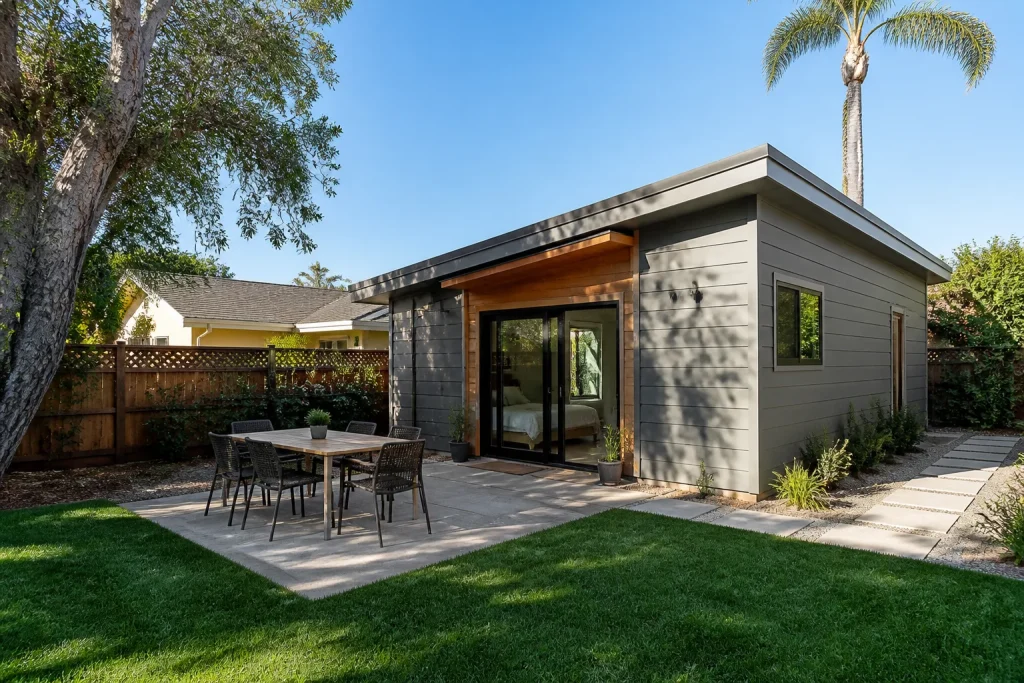
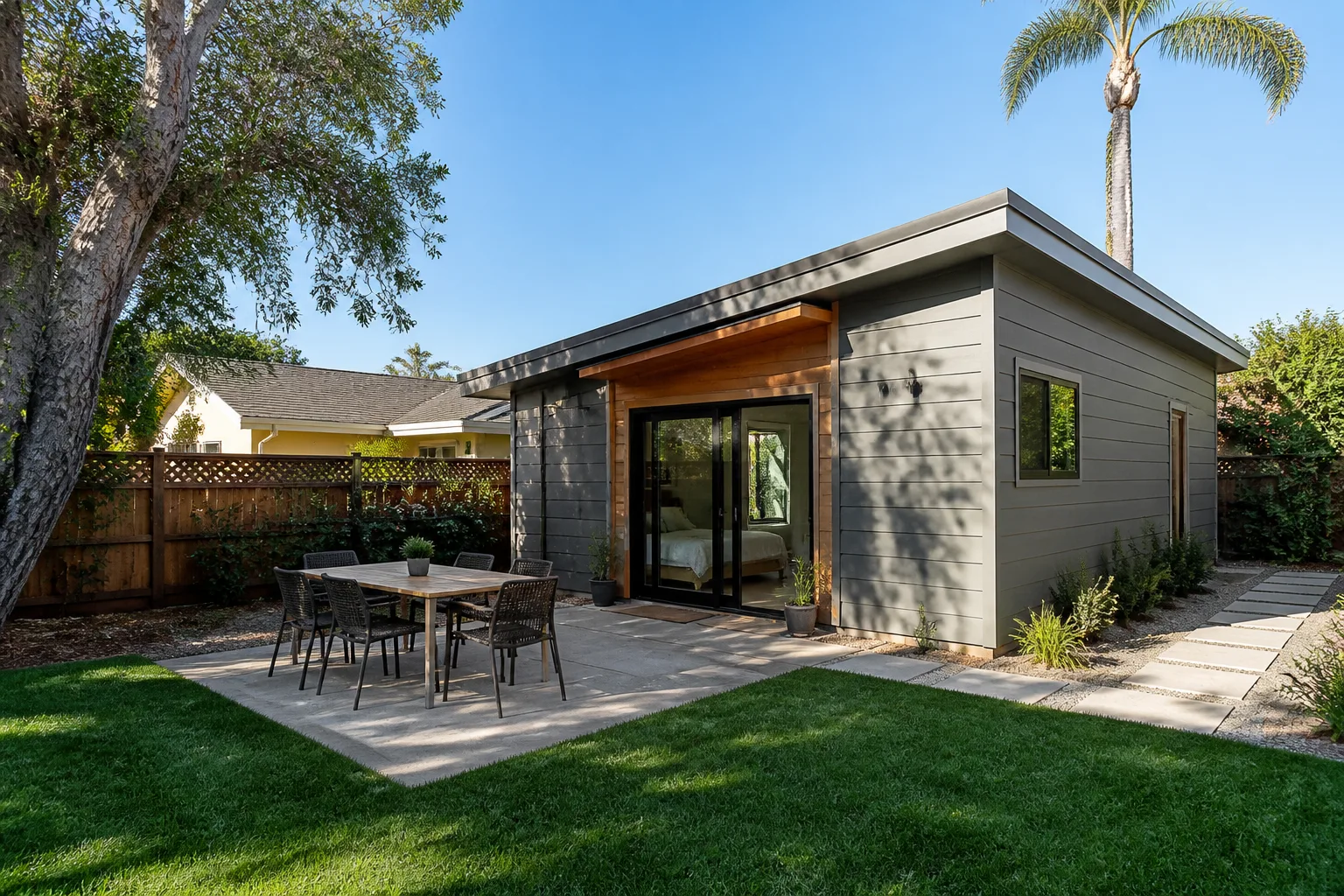
James Hardie ADU Builders in Los Angeles: A Homeowner’s Guide
Most ADU builders in Los Angeles will tell you they “use James Hardie products,” but fewer than you’d expect hold the HardieZone certification that actually validates a proper install. That distinction matters more than you think, because a botched fiber-cement job voids the 30-year product warranty on day one. Here’s what you need to know before you sign anything: Hardie siding on a Los Angeles ADU is a fire-resistance and insurance-premium decision as much as a cosmetic one. Get the installer right, and you’re looking at lower premiums in high-risk fire zones, a 30-year product warranty, and a cladding that holds its paint for a decade and a half. Get it wrong, and the warranty evaporates before the first rain hits. If you’d rather skip the research and talk to someone who does this every day, call (903) 225-2278 and we’ll walk you through it.
Benson ADU Builders in Los Angeles. We’ve installed James Hardie cladding on ADUs from Sunland to San Pedro, and I’ll share what actually matters when you’re vetting a builder.
Why James Hardie on an LA ADU Isn’t Just a Style Choice
Los Angeles sits across a patchwork of fire hazard severity zones, and if your ADU falls inside a Very High Fire Hazard Severity Zone, your siding choice is effectively a building-code question before it’s a design question. LA County’s Chapter 7A ignition-resistant construction standards require specific materials for exterior walls in certain zones, and James Hardie’s fiber-cement products carry a Class A fire rating, which means they don’t contribute fuel to a fire the way wood or vinyl siding can. That’s the difference between passing a Wildland-Urban Interface inspection on the first visit versus the third.
Beyond fire, there’s the insurance angle. Homeowners we work with in Los Angeles regularly report that insurers look more favorably on fiber-cement cladding compared to wood or stucco in high-risk areas. Some see premium reductions, others simply keep coverage without a cancellation notice. The point is, Hardie siding on an ADU in a fire-prone corridor is a defensive financial decision, not just a handsome one.
And the material is genuinely tough in ways that matter for ADUs specifically. Detached ADUs sit inches from fences, neighbors, and overgrown citrus trees. Hardie’s fiber-cement boards resist rot, won’t sustain termites, and shrug off the salt air you get in neighborhoods like Playa del Rey or Wilmington. In our experience, it holds up far better than wood lap siding on a rental ADU that might not get repainted on a perfect schedule.
Certified Installer vs. Guy with a Lumber Yard Account
Any general contractor in Los Angeles can walk into a lumberyard and buy HardiePlank. The product is for sale everywhere. What that contractor can’t buy at the counter is the training and the manufacturer’s backing that come with being a James Hardie Certified Installer.
Here’s the difference at ground level:
- Warranty validity. James Hardie’s 30-year non-prorated substrate warranty applies when the product is installed per Hardie’s printed installation requirements. A certified installer has demonstrated that they know those requirements. A non-certified builder who guesses at fastener spacing, flashing details, or joint treatment can void your warranty on a technicality you won’t discover until year 12.
- HardieZone specification. James Hardie makes different product lines tuned for different climates. In Los Angeles, that’s HardieZone HZ5 for coastal neighborhoods and HZ2 for drier inland zones like the San Fernando Valley. A certified installer knows which product spec applies where and why. A builder grabbing whatever’s on the rack might not.
- Flashing and moisture management. The number one reason fiber-cement installations fail in Southern California isn’t the board. It’s improper flashing behind the board. Certified training covers the wall assembly as a system: WRB, flashing, drainage plane, then cladding.
- Manufacturer recourse. If something goes wrong on a certified install, you have a clear path back to the manufacturer. On an uncertified install, you’re arguing with a contractor’s cell phone voicemail.
Ask a builder directly: “Are you a James Hardie Certified Installer, and can I see the certification?” If the answer is a shrug, keep dialing. At Benson ADU Builders, we hold the certification and put it on the table before you ask, because it’s the only way we can stand behind the Done Right Promise on a Hardie install.
We pulled a Hardie panel off a garage conversion in North Hollywood last month where the previous builder had butted the boards tight against the window trim with no gap and no flashing. Water had wicked behind the boards for two seasons, and the bottom six inches of the wall were quietly turning to compost. The boards looked perfect from the street. It’s a expensive lesson in why installation matters more than the logo on the wrapper.
HardiePlank, HardiePanel, HardieTrim: Which Belongs on Your LA ADU
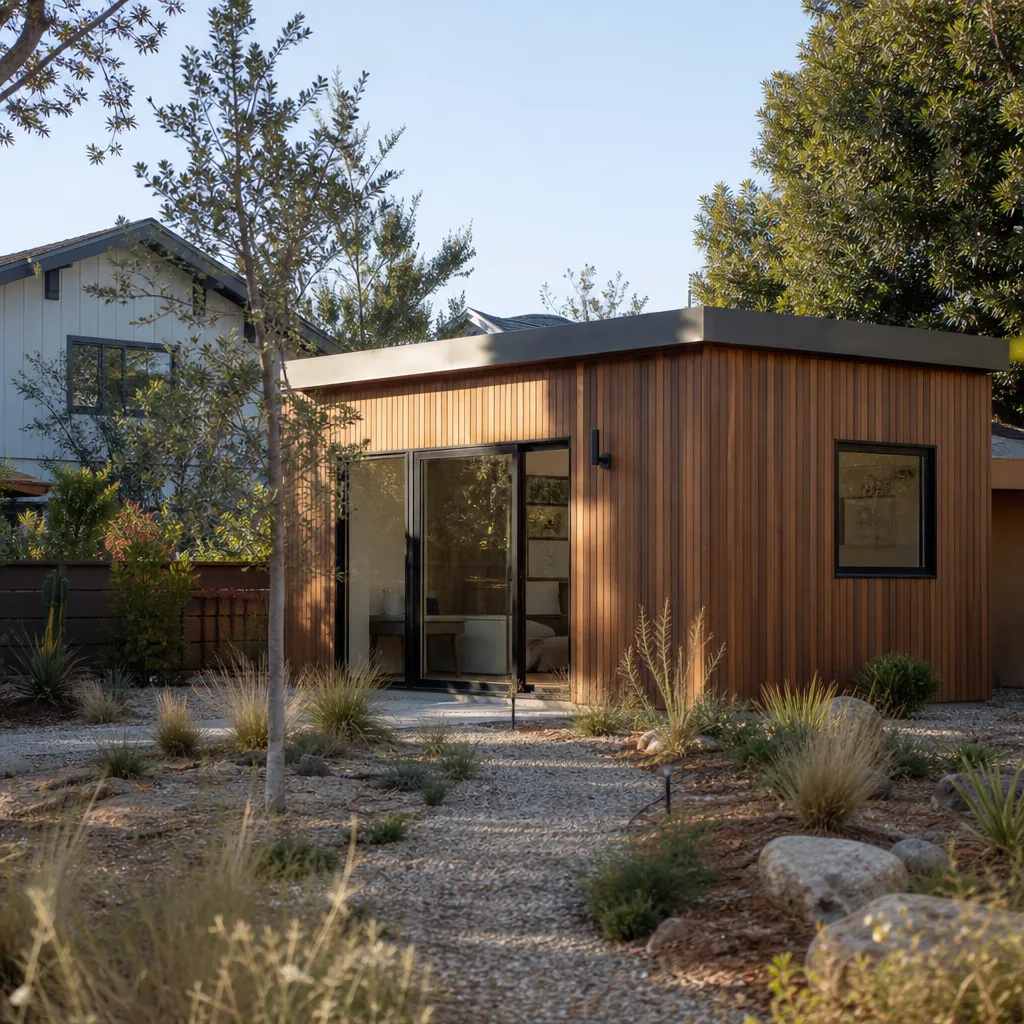
James Hardie makes three primary product lines for exterior cladding, and they suit different Los Angeles contexts.
HardiePlank (Lap Siding)
The horizontal lap board most people picture when they think of fiber-cement siding. It fits the traditional California bungalow look and matches well with stucco or painted brick main houses in neighborhoods like Highland Park or West Adams. For ADUs, it’s a good choice when you want the addition to read as a natural extension of the original house rather than a prefab box dropped in the yard.
HardiePanel (Vertical Siding)
A large sheet product that gives a more modern, panelized aesthetic. We frequently spec this on ADUs from Plant Prefab or Abodu, because the cleaner, vertical lines read as contemporary and the larger sheet size cuts down on seam count. In coastal Los Angeles zones like Venice or Long Beach, HardiePanel’s face is designed for HZ5 exposure, which means it tolerates wind-driven rain and salt air better than wood-based sheet goods.
HardieTrim (Boards and Battens)
The dimensional trim pieces for corners, windows, door surrounds, and fascia. It’s often the failure point on a poor install: if trim isn’t properly flashed and sealed, water gets behind the board and starts working on the sheathing. HardieTrim has a good track record in Los Angeles if, again, the installer actually follows the installation spec.
The right answer for most LA ADUs is a combination: HardiePanel for the bulk of the wall, HardieTrim at corners and openings, and maybe a band of HardiePlank for a design accent. A proper builder walks you through options instead of defaulting to whatever the crew knows fastest.
What James Hardie Cladding Costs on a Los Angeles ADU
Let’s get real about numbers, because too many Los Angeles builders dance around pricing until the contract is already half-signed.
For a typical 400 to 600 square foot ADU in Los Angeles, you’re looking at roughly 900 to 1,400 square feet of exterior wall surface, depending on wall height and window count. James Hardie cladding, materials plus certified labor, generally lands between $14 and $22 per square foot of installed wall. That’s the realistic range in the current LA market.
Do the math and you get:
| ADU Size | Approximate Wall Area | Hardie Cladding Range |
|---|---|---|
| 400 sq ft | 900 – 1,100 sq ft | $12,600 – $24,200 |
| 500 sq ft | 1,100 – 1,300 sq ft | $15,400 – $28,600 |
| 600 sq ft | 1,300 – 1,400 sq ft | $18,200 – $30,800 |
If a Los Angeles builder quotes you $8 per square foot installed for “Hardie,” treat the number like a warning light. That’s either a labor crew that’s never touched fiber cement, a materials substitution you haven’t been told about, or a lowball that becomes a change order the moment the crew opens the first box. Hardie materials alone run $5 to $8 per square foot at LA suppliers, and proper installation labor is the largest cost line after the panels themselves.
Every Benson ADU Builders proposal includes a written line-item price for cladding, broken out from framing and finishes, so you can see exactly what the Hardie component costs before work starts. That’s part of the Relay Visibility Guarantee: no verbal estimate, no handshake number, no “we’ll figure it out when we get there.”
Chapter 7A, Class A Fire Ratings, and Your ADU in a VHFHSZ
If your Los Angeles property sits inside a Very High Fire Hazard Severity Zone (VHFHSZ), which includes large parts of the Santa Monica Mountains, the Verdugos, and the hills above Porter Ranch, your ADU’s exterior walls need to comply with LA County’s Chapter 7A ignition-resistant construction standards.
James Hardie fiber-cement siding carries a Class A fire rating, the highest rating available for a combustible exterior wall assembly. Class A means the material has demonstrated it won’t produce flame spread or contribute significant fuel in a standardized test. For a detached ADU sitting 10 feet from a zone-required defensible-space line, that rating matters.
But here’s the nuance that most guides skip: the fire rating applies to the system, not the board alone. A Class A-rated board nailed over an improperly detailed wall assembly with gaps at corners and open soffit vents can still allow ember intrusion. Embers, not direct flame, cause most wildfire-related structure losses in California. Your Hardie board is one layer in a system that includes ember-resistant vents, proper eave detailing, and defensible-space compliance.
When we spec a James Hardie install on an ADU in a Los Angeles VHFHSZ, the written scope of work includes Chapter 7A compliance notes for the entire wall assembly, not just the cladding. That’s the difference between a quote that gets an ADU through plan check and one that bounces back for revisions at the county.
What a Written Scope of Work for a Hardie Install Should Include
When you’re comparing bids from James Hardie ADU builders in Los Angeles, the written scope of work is where honest contractors separate themselves from the rest. If a builder hands you a one-page quote that says “James Hardie siding, all walls” and nothing else, that’s a red flag.
A proper scope of work for a Hardie installation on an LA ADU covers these specifics:
- Product line and HardieZone designation, listed by name: HardiePlank HZ5 lap siding, 5/8″ thickness, primed, at 6″ exposure. Not just “Hardie.”
- Fastener schedule, because James Hardie requirements differ by product and substrate, and a mismatch causes cracked boards and popped nails.
- Joint treatment and flashing details, including the flashing specification at butt joints, window heads, and door heads, and the treatment where Hardie meets stucco or brick on the main house.
- WRB (weather-resistant barrier) specification, named and quantified, with overlap callouts at horizontal seams.
- Paint and finish system, with the product name and the finish warranty in writing, because Hardie boards ship primed but the field paint is a separate system with its own durability timeline.
- Inspection checkpoints, so you know which stages require a visible stop before the next layer goes on: framing inspection, WRB inspection, cladding inspection, final.
- Warranty registration procedure, because the Hardie warranty has a registration process and the installer should handle it, not leave you with a card in a box.
Every Benson ADU Builders contract includes a scope of work with this level of specificity, in plain English, so you don’t need a construction dictionary to understand what you’re paying for. And because the Done Right Promise is written into the agreement, we have a strong incentive to get every one of those details right the first time.
When to Call a Pro – and What to Ask Before You Do
If you’re attaching James Hardie cladding to an ADU in Los Angeles, this isn’t a homeowner weekend project. The boards are heavy, the cutting creates silica dust that requires proper respirator protection, and the flashing details around windows and doors are unforgiving. A wrong cut means a wasted board at fifty-plus dollars a pop, and a wrong flashing detail means water damage you won’t see for a year.
Before you call anyone, have these questions ready:
- Are you a James Hardie Certified Installer? Can I see the credential?
- Which Hardie product line are you specifying, and which HardieZone?
- What’s your per-square-foot installed price, and is it written in the contract?
- How do you handle the warranty registration?
- What does your written scope of work cover, exactly?
If the answers come fast, specific, and in writing, you’re talking to the right kind of builder. If you hear “trust me” or “we always do it that way,” call the next number.
Related services in Los Angeles: home additions and room additions use the same cladding standards and scrutiny, so if you’re planning a larger project alongside your ADU, the vetting process is identical.
The Bottom Line
James Hardie cladding on a Los Angeles ADU is a smart move for three reasons: measurable fire resistance in high-risk zones, a 30-year product warranty when installed by a certified professional, and paint durability that reduces maintenance on a rental property. But the product is only as good as the installer’s hand, and Los Angeles has plenty of builders who will slap up fiber cement and call it done. Ask for the certification. Ask for the written scope. Ask for the price in writing.
If you’re in Los Angeles and need help with a James Hardie ADU build or cladding on an existing structure, Benson ADU Builders offers free estimates. Call (903) 225-2278 and we’ll walk your project, talk product lines, and give you a written price before any work starts. No pressure, no runaround, no numbers that change at the door.
Frequently Asked Questions
For a 400 – 600 square foot ADU in Los Angeles, expect to pay $14 to $22 per square foot of installed wall area for James Hardie cladding, which typically totals $12,600 to $30,800 depending on your ADU’s wall surface and product selection. That includes certified labor, materials, and proper flashing. A quote under $10 per square foot installed should be treated cautiously, since it usually indicates uncertified labor or a scope that will change once the job starts. Call (903) 225-2278 for an exact quote, based on your ADU’s actual plans and wall area. Estimates are free.
You don’t legally need a certified installer, but the 30-year James Hardie product warranty is only valid when the material is installed per the manufacturer’s printed spec, and certification is the cleanest proof a builder knows that spec. A non-certified installer can void your warranty with improper fastener spacing, missing flashing, or wrong HardieZone product selection. In Los Angeles, where fire-zone compliance and coastal moisture both put stress on the wall assembly, ask for the certification before you sign.
Yes, James Hardie fiber-cement products carry a Class A fire rating, which satisfies the ignition-resistant exterior wall requirements in LA County’s Chapter 7A construction standards for Very High Fire Hazard Severity Zones. However, the rating applies to the whole wall assembly, not just the board, so ember-resistant vents and proper eave details must be included in the scope. A written scope of work that calls out Chapter 7A compliance is the safest way to pass plan check on the first submittal.
Not if your contract includes a written line-item scope of work. Price changes on siding jobs usually come from scope gaps: the original quote omitted flashing, the wall area estimate was off, or the crew encountered rotted sheathing that wasn’t accounted for. At Benson ADU Builders, every James Hardie cladding proposal includes a written price for the full scope before work starts, governed by the Relay Visibility Guarantee, so you won’t see a change order unless you request a change yourself. Call (903) 225-2278 to get your written estimate started.
Written by , Owner at Benson ADU Builders, serving Los Angeles.
Need ADU Help?
Call Benson ADU Builders - licensed & insured, here with fast after-hours help in Los Angeles.
(903) 225-2278