
5 Mistakes to Avoid With ADU Builders
Most ADU projects in Los Angeles don’t go sideways because of bad design. They go sideways because the contract, the communication, and the warranty were never put in writing before the first permit was pulled. We’ve seen five specific mistakes cost homeowners between $18,000 and $65,000 on what should have been a straightforward build. Here’s what they are and how to avoid every one of them.
Mistake #1: Accepting a Verbal Estimate
In California, a verbal estimate is legally meaningless. If a builder tells you your ADU will run $180,000 over the phone and then hands you a bill for $245,000 at drywall, you have no contract to point to and no legal footing to dispute the difference. The number that matters is the one written into a signed fixed-price scope of work.
A real fixed-price scope lists every line item: foundation, framing, roofing, electrical panel upgrade, plumbing rough-in, drywall, paint, flooring, and the final inspection. It says what’s included and what’s not, and it locks the price. We’ve seen change orders in Los Angeles add $30,000 to $50,000 on top of the original estimate when the scope was vague. Things like trenching for utilities, upgraded electrical service to 200 amps, and sewer line connections get “discovered” mid-project and billed as extras.
Before you sign anything, ask the builder this exact question: “Is this the final price in writing, or does anything change once we start?” If the answer involves the word “depending,” walk away. A written price before work starts is the single biggest predictor of whether your ADU finishes on budget. It’ll save you more money than any finish-level decision, and it should sell you on the builder faster than any portfolio photo.
Mistake #2: Skipping the CSLB License Check
Every ADU builder in Los Angeles must hold a valid California Contractors State License Board license. Checking it takes three minutes at cslb.ca.gov and it’s the most important three minutes of your entire project. Here’s what to look up:
- License status: It must read “Active.” Anything else – expired, suspended, revoked – means the contractor cannot legally work.
- Bond status: California requires a $25,000 contractor bond. If the bond reads “canceled,” the contractor lost their financial backing and you have no recourse if they take your deposit and disappear.
- Insurance status: Workers’ compensation and general liability should both be current. Without workers’ comp, an injured worker on your property becomes your lawsuit.
- License classification: For an ADU, you want a “B” (General Building Contractor) classification.
We’ve seen homeowners in Los Angeles hand $40,000 deposits to unlicensed operators who then vanished. The license check would have stopped that in 180 seconds. The CSLB also maintains a public record of complaints and disciplinary actions, so you can see if the builder has a pattern of disputes. It’s free, it’s public, and it should be done before you agree to a single site visit. If a builder is too busy to provide their license number, they’re too busy to build your ADU.
Mistake #3: Choosing a Builder With No Prefab Access
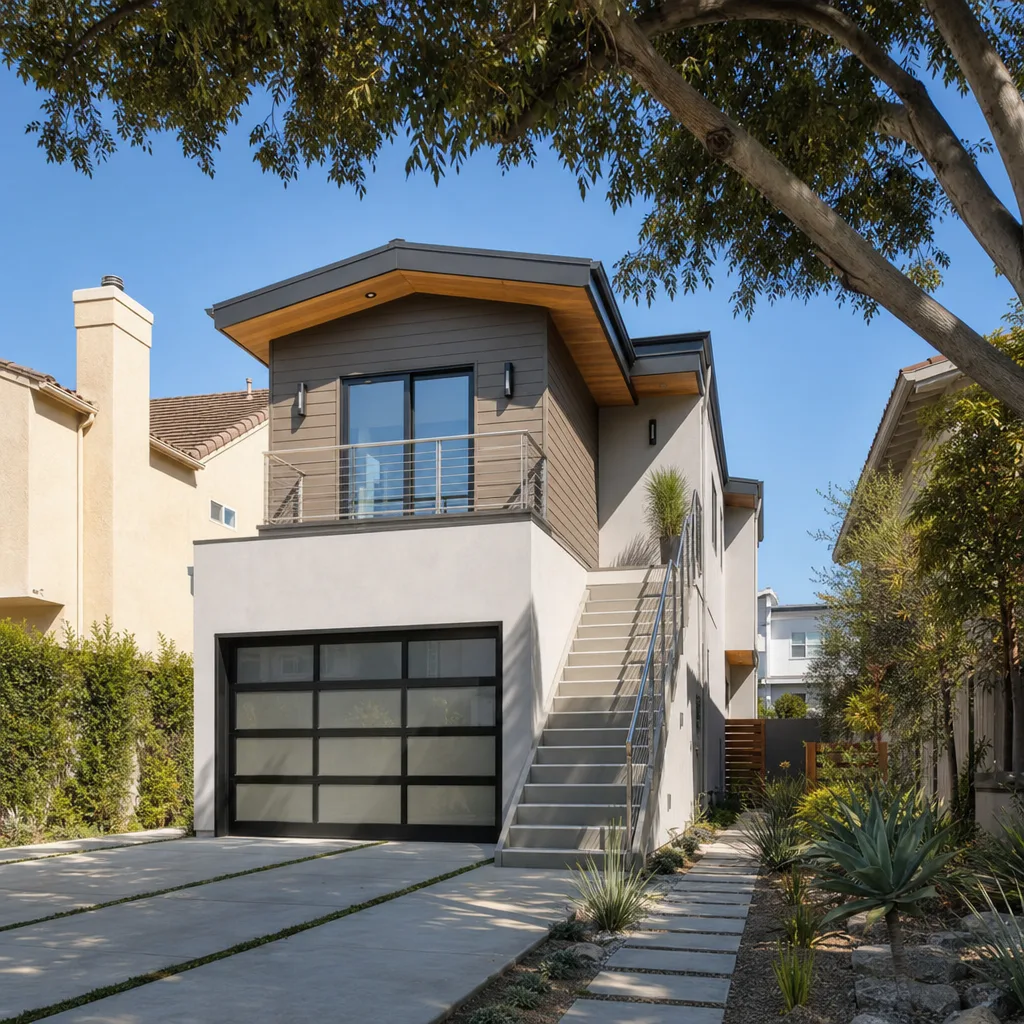
Here’s the reality of Los Angeles ADU construction in 2026: a stick-frame-only builder locks you into the slowest, most expensive path to a finished unit. Site-built ADUs in LA typically take 9 to 14 months and cost $350 to $550 per square foot when you account for labor, weather delays, and the inevitable change orders. Prefab ADUs from brands like Abodu, Cover, and Dvele can cut construction time to 4 to 7 months because the panels and modules are manufactured off-site while the foundation is being poured on-site.
That’s not a small difference. Four months of construction loan interest, temporary housing, or lost rental income can easily run $2,500 to $4,000 per month in Los Angeles. A builder who can only frame on-site isn’t giving you a bad product – they’re just not giving you options. And options are where the savings live.
When you’re interviewing builders, ask which prefab brands they’re authorized to work with. A builder who can source from Abodu, Cover, or Tuff Shed can show you real floor plans, real pricing sheets, and real delivery timelines from the first conversation. A builder who says “we only do custom stick-frame” may simply not have the relationships or the volume to access factory-built panels. James Hardie cladding is another tell: builders who stock or routinely install it are set up for efficient exterior finishing, not ad-hoc runs to a lumber yard.
Mistake #4: No Real-Time Project Visibility
“We’ll call you with updates” is the most broken promise in Los Angeles construction. The reality is that most builders disappear between permit approval and the first inspection, and homeowners are left emailing into a void wondering whether the crew even showed up that week.
What you want instead is a written tracking commitment before work starts. That means the builder agrees to provide a live timeline you can check from your phone, photo documentation at key milestones, and predictable arrival windows for crews. Rideshare apps set this standard for everyone under 45. A builder who knows when their crew will arrive and can prove the work got done is a builder who respects your time and your money.
Ask for this before you sign: “How will I track progress in real time, and what documentation will I receive?” If the answer is “we’ll keep you posted,” you’ve found your mistake. The right answer is a builder who puts the tracking promise in the contract, with specific milestones – foundation, framing, rough electrical, drywall, final inspection – each tied to written updates and photos. That’s the only way you’ll know your ADU is on schedule without driving to the job site every morning.
Mistake #5: Ignoring the Workmanship Warranty in Writing
Every builder says they stand behind their work. Almost none put it on paper with a defined length and a defined remedy. A verbal “one-year warranty” means nothing when a roof leak shows up at month 11 and the builder’s phone goes to voicemail.
What you need is a warranty that answers three questions in writing. First, how long does coverage last? A written guarantee is the minimum you should accept – it covers a full seasonal cycle, including LA’s winter rain. Second, what exactly is covered? Workmanship defects, installation failures, and covered repairs should all be named. Third, what happens if something goes wrong? The warranty should specify a free second visit to fix any covered repair that fails.
Read that warranty before you sign the contract, not after. If the builder can’t hand you the guarantee in writing on day one, treat that as a refusal. In our experience, the builders who won’t put a warranty in writing are the ones who already know they won’t honor it. The written promise is what separates a professional from a gambler with a nail gun.
What to Do If You’ve Already Made One of These Mistakes
If you’ve already signed a vague estimate or skipped the license check, you’re not stuck. First, send a written request (email works) asking the builder to clarify the scope in writing and provide their CSLB license number. In California, you have the right to request these. If they refuse, start documenting everything: every text, every invoice, every change order request. Second, consider a contract attorney who specializes in construction law – it’s a few hundred dollars for a review that can save you tens of thousands in disputed extras. Third, if the project has already started and you’re seeing scope creep, put the builder on written notice that no additional work is authorized without a signed change order.
The good news is that all five of these mistakes are fixable before work starts. They’re process problems, not product problems. Fix the process and the product takes care of itself.
Key Takeaways
- A verbal estimate in California is worth the paper it’s printed on – nothing. Demand a written fixed-price scope.
- Run the CSLB license check at cslb.ca.gov before you agree to a single site visit. It takes three minutes.
- Prefab access from brands like Abodu, Cover, and Tuff Shed can save four to six months and $30,000+ on an LA ADU.
- Real-time tracking is a written commitment, not a verbal promise.
- A written warranty is the minimum standard. Verbal warranties don’t count.
When to Call a Professional
If you’re reading this and realizing the builder you’re talking to has already made two or three of these mistakes, it’s time to have a different conversation. The ADU market in Los Angeles is crowded with contractors who will promise anything to get a deposit. The right builder will volunteer their license number, show you a written fixed-price scope before you ask, and put their warranty in writing on day one. If yours won’t do those three things, call someone who will.
The Bottom Line
The five mistakes that cost Los Angeles homeowners the most money aren’t about countertops or windows. They’re about contracts, communication, and commitments made in writing. Fix those five things before you sign and you’ve already eliminated the bulk of ADU cost overruns and delays. If you’re in Los Angeles and want to see what a written fixed-price ADU scope looks like, Benson ADU Builders offers free estimates with no obligation – call (903) 225-2278 and we’ll walk you through the numbers before you spend a dollar. We’re part of the Relay Home Co. family, and every project we take on comes with a written price before work starts, a Done Right Promise, and a written guarantee on every ADU.
Frequently Asked Questions
Most Los Angeles ADUs run between $180,000 and $350,000 depending on size, site conditions, and whether you choose prefab or site-built. Prefab units from brands like Abodu or Cover typically land on the lower end of that range because factory construction removes weather delays and on-site labor overflow. The number that matters is the one you get in writing from a builder who has walked your specific lot. Call (903) 225-2278 for a free estimate with real line items, not a ballpark guess.
It should not, and if it does, that’s a red flag. A true fixed-price scope means the price is locked unless you request a change. The exceptions are legitimate unknowns like unpermitted existing work or hidden soil conditions, and those should be disclosed in writing before you sign. If a builder starts adding costs without a signed change order, stop the work and call (903) 225-2278 for a second opinion.
Site-built ADUs typically take 9 to 14 months from permit to final inspection. Prefab ADUs can finish in 4 to 7 months because the structure is built in a factory while the foundation is poured on-site. The builder you choose should give you a written timeline with milestones, not a verbal estimate that stretches into next year.
Yes. Every Benson ADU Builders project includes a Done Right Promise in writing. If the work isn’t right within a full year, we make it right. The guarantee is stamped on every project we build, and it includes a free second visit if any covered repair fails. That’s the difference between a verbal promise and a piece of paper you can hold us to.
Written by the team at Benson ADU Builders.
Need ADU Help?
Call Benson ADU Builders - licensed & insured, here with fast after-hours help in Los Angeles.
(903) 225-2278