
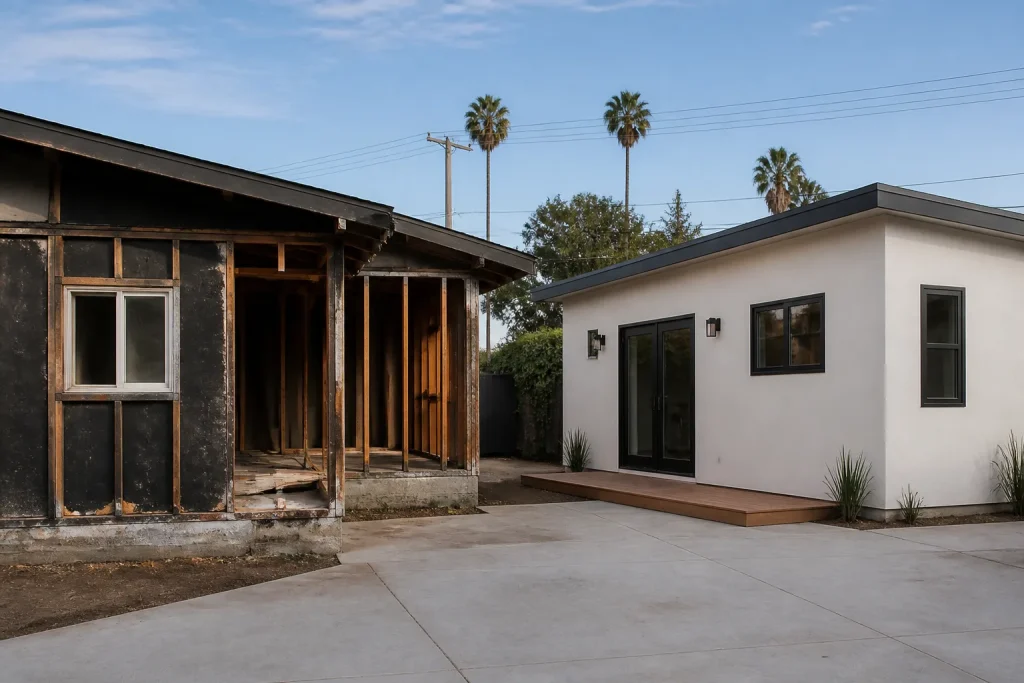
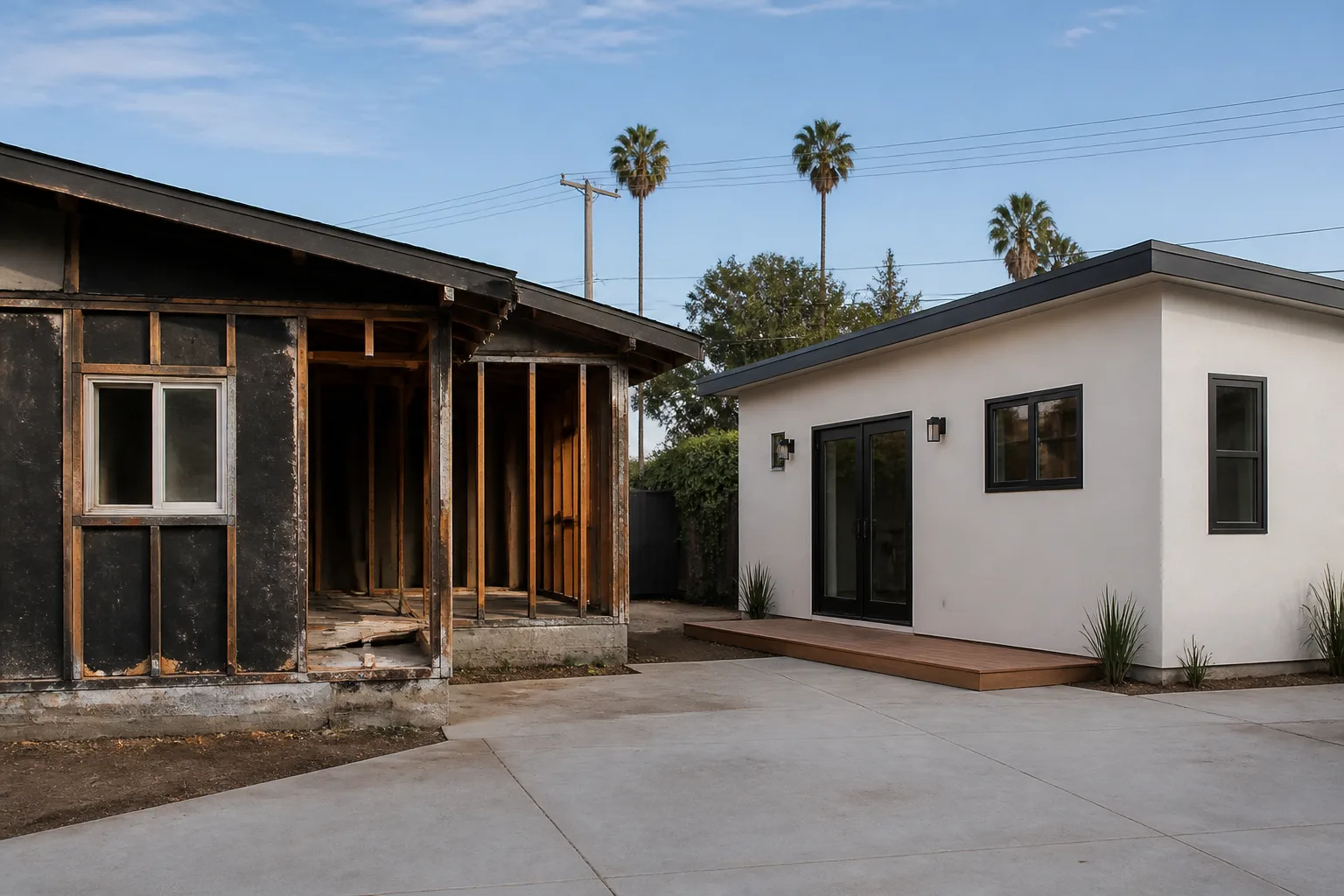
ADU Builders: Repair or Replace? How Los Angeles Homeowners Decide
For most Los Angeles homeowners with an older backyard unit, garage conversion, or unpermitted “granny flat,” the repair-or-replace decision comes down to two numbers nobody tells you about until it’s too late: what you’ll owe in retroactive code-violation fines once a permit gets pulled, and how much rental income you lose every day the unit sits empty. Repair feels cheaper on the surface, but once you factor in those two costs, replacement with a prefab ADU wins more often than you’d think. If you’d rather skip the math and get a straight answer, call (903) 225-2278 and we’ll walk the property with you.
Here’s the honest framework we use with homeowners across Los Angeles. It’s the same one we’d use on our own backyards.
Key Takeaways
- An unpermitted rental unit in Los Angeles can trigger fines up to $5,000 per day once a permit application exposes it.
- The 50% rule often makes a permitted prefab rebuild cheaper than repairing a deteriorated structure.
- Prefab ADUs from brands like Abodu and Tuff Shed can be installed in 8 to 12 weeks, versus 6 months or more for a permitted structural repair.
- A written, itemized estimate is the only document that makes your repair-or-replace call defensible to a bank or insurance company.
First, Pull the Permit History. It Takes 10 Minutes and Changes Everything.
Before you spend a dollar on architectural drawings or contractor estimates, find out whether your existing structure has any permits at all. Los Angeles County makes this easier than people expect. The Department of Building and Safety has an online portal where you can search your address and pull up every permit ever filed on the parcel. Most homeowners can do this in under ten minutes with nothing more than their address and parcel number.
What you’re looking for is simple: does a permit exist for the original structure, and does it match what actually stands on the property today? “No permits found” is not a neutral finding. It means the city has no record the unit was ever built to code, which means the moment any contractor files a permit for work on that structure, the entire unit becomes subject to current code review. In Los Angeles, that can mean bringing electrical, plumbing, foundation, and egress up to today’s standards, not the standards from whenever the unit went up.
We’ve pulled one out of a garage in Van Nuys where the owner thought he was looking at a $15,000 cosmetic refresh. The permit search showed the garage conversion was never permitted, and it had been rented for eight years. The city’s retroactive fine structure for unpermitted rental units in LA County can run up to $5,000 per day for knowing violations. His repair-or-replace decision made itself once he saw that number.
If the permit history is clean, repair becomes a realistic option. If it’s not, you need to price the legal exposure before you price the drywall. Nobody tells you this in a flyer.
Related reading: ADU Builders in Los Angeles.
The 50% Rule: When Repair Legally Becomes Rebuild
Los Angeles building code, like most jurisdictions in California, uses a threshold called the 50% rule. Here’s the short version: if the cost of your proposed repairs exceeds 50% of the replacement value of the structure, the building department can require you to bring the entire structure up to current code, not just the part you’re fixing. Replacement value means what it would cost to rebuild that same structure new, at current labor and material rates in Los Angeles.
Let’s put numbers on it. Say you have a 400-square-foot garage conversion that would cost roughly $120,000 to rebuild from scratch at typical Los Angeles rates. The 50% rule means once your repair estimate passes $60,000, the inspector can legally ask you to upgrade everything: seismic anchoring, electrical service, insulation, window egress, the works. What started as replacing a sagging roof and some dry rot suddenly becomes a six-figure code-compliance project with a repair permit attached.
That’s the exact moment replacement stops being the expensive option. A new prefab ADU from a brand like Abodu arrives as a factory-built, code-compliant unit that gets set on a prepared foundation. No inspector is going to flag latent issues inside a wall that was assembled in a controlled facility. The unit ships with compliance baked in, and the permit moves through because the product is pre-reviewed by the state.
The same logic applies to Tuff Shed upgrades. A Tuff Shed shell costs a fraction of what a full site-built ADU costs, and when finished with insulation, electrical, and drywall by a licensed contractor, it creates a habitable space under accessory structure rules in many Los Angeles jurisdictions. For a deteriorated garage at the end of its useful life, a Tuff Shed replacement with James Hardie cladding often lands well below the cost of a full code-upgrade repair.
Related reading: Home Addition Contractor in Los Angeles.
The Rental-Income Clock: Repair Costs You Money Every Day It’s Empty
Most homeowners compare repair cost against replacement cost and stop there. That’s the mistake.
A permitted structural repair on a deteriorated Los Angeles ADU takes four to six months when it goes smoothly. Demo, shoring, framing corrections, electrical rough-in, inspections, drywall, finish work, final inspection. That’s a conservative timeline. Meanwhile, a detached ADU in a decent Los Angeles neighborhood rents for $1,800 to $2,800 a month, with one-bedrooms in higher-demand areas pushing past $3,000. If your unit sits empty for five months during repair, that’s $9,000 to $15,000 in lost rent. Add that to your repair estimate and compare again.
A prefab replacement changes the clock. An Abodu unit, for example, is built in a factory while site prep happens in your backyard. Foundation work, utility trenching, and the factory build happen simultaneously, not sequentially. Total timeline from signed contract to move-in: typically 8 to 12 weeks in Los Angeles, depending on jurisdiction and site conditions. That’s two to three months of vacancy instead of five or six.
If you’re renting the unit for $2,400 a month, the prefab path saves you somewhere in the range of $7,000 to $9,000 in lost rent alone, before you even look at construction costs. That’s real money, and it’s why we tell Los Angeles homeowners to run the math both ways before deciding.
When to call a pro: if pulling your own permit history turns up anything you don’t understand, or if you have any structural concerns (cracks wider than a quarter inch, floors that slope, door frames out of square), stop there. Structural issues on occupied or previously occupied living spaces in Los Angeles are not a YouTube tutorial situation. A licensed contractor or structural engineer needs eyes on it.
The Unpermitted Liability Trap: Why “Just Fix It Quietly” Is a Six-Figure Risk
Here’s the scenario we see over and over in Los Angeles. A homeowner inherits a property with a garage that was converted into a rental unit in the 1990s. No permits. The tenant moved out. The homeowner figures they’ll fix it up quietly, paint it, re-rent it, and nobody asks questions.
The problem is that Los Angeles rental units get noticed. Insurance claims, neighbor complaints, a new tenant who reports an electrical issue to the housing department, or simply the city’s own rental registry requirements in certain jurisdictions, any of these can trigger a code enforcement visit. At that point, the city is not asking about permits. They’re citing you for the violation, and once you’re cited, the meter is running. LA County code enforcement penalties for unpermitted dwelling units can reach $1,000 per day, and knowingly renting an unpermitted unit can push liabilities toward $5,000 per day in certain circumstances.
“Fixing it up a little” without addressing the permit question doesn’t remove that exposure, it just adds new drywall on top of it. The only paths out of the trap are: bring the unit into compliance (which may cost more than the structure is worth), remove the unit, or replace it with a permitted, code-compliant build that clears the violation history.
This is exactly why we make the permit-history check the first step in every Los Angeles ADU consultation we do. The answer to “repair or replace?” usually lives in that five-page document from Building and Safety.
If you want a no-pressure read on your specific situation, Benson ADU Builders home has more on how we handle these assessments, and the phone always gets answered by a real person at (903) 225-2278.
Why a Written Estimate Is the Only Document That Matters
Verbal estimates are worthless when you’re making a repair-or-replace decision on a rental property in Los Angeles. Not because they’re dishonest, but because they don’t create a record. If you later need to show a lender why you chose replacement, or explain to an insurer why you didn’t sink $80,000 into a structure that couldn’t be brought to code, you need paper.
A proper written estimate from a licensed Los Angeles contractor should itemize every line: demo, foundation work, framing, rough plumbing, rough electrical, insulation, drywall, finish electrical, flooring, paint, permits, engineering. When it’s itemized, you can make a real comparison between the repair path and the replacement path. You can also take that document to the building department and ask directly: “at this scope, does the 50% rule apply to my structure?”
At Benson ADU Builders, every project gets a written price before work starts. Not a range. Not a ballpark scribbled on a business card. A line-item document you can take to your lender, your insurer, or your spouse. That written estimate includes permit fees, engineering, materials, labor, and the prefab brand you selected, whether it’s an Abodu unit, a Cover panelized build, or a finished Tuff Shed.
And yes, we still write these out for clients who end up going with another contractor. The document matters more than the sale. If you’re in Los Angeles and need one, call (903) 225-2278 and ask for it by name.
Related reading: Room Addition Contractor in Los Angeles.
The Bottom Line
Repair makes sense when the permit history is clean, the structure is fundamentally sound, and the repair estimate stays comfortably under that 50% threshold. Replace makes sense when the unit was never permitted, when structural issues run deep, or when you’d lose more rent during a long repair than you’d save on construction costs. In our experience across Los Angeles, the majority of older backyard units with unknown histories end up on the replacement side of that line once the real numbers hit the table.
Every project we do carries a written price before work starts and our Done Right Promise in writing. If you’re in Los Angeles and want a straight answer on your specific structure, Benson ADU Builders offers free estimates. Call (903) 225-2278 and we’ll pull the permit history with you.
Frequently Asked Questions
Search your address on the Los Angeles Department of Building and Safety online permit portal. It takes about ten minutes. If you find no permit matching the structure that stands today, treat the unit as unpermitted and factor in potential compliance costs before deciding to repair. Call (903) 225-2278 if you want a contractor to do the search with you.
A finished prefab ADU from a brand like Abodu or a permitted Tuff Shed conversion typically runs $120,000 to $350,000 in Los Angeles, depending on size, site conditions, and finish level. Repairs on a deteriorated structure can climb past $80,000 to $120,000 once code upgrades kick in. The gap between the two is often smaller than homeowners expect, especially when you factor in lost rent during a longer repair. Call (903) 225-2278 for a written estimate on your specific property.
With Benson ADU Builders, no. The Relay Visibility Guarantee means you get a written price before any work begins, and that price holds unless you change the scope. Every project also carries our Done Right Promise: if something isn’t right within a full year, we make it right. Estimates are free, call (903) 225-2278.
Most prefab ADUs from brands like Abodu install in 8 to 12 weeks from permit approval to move-in, because the factory build happens while site prep runs in parallel. A permitted structural repair typically takes four to six months. That timeline difference directly affects your rental income, which is why it belongs in the repair-or-replace calculation.
Written by the team at Benson ADU Builders.
Need ADU Help?
Call Benson ADU Builders - licensed & insured, here with fast after-hours help in Los Angeles.
(903) 225-2278