Mighty Buildings Junior ADU Conversion: The Los Angeles Owner’s Guide
For a Mighty Buildings junior ADU conversion in Los Angeles, most owners spend $55,000 – $95,000 installed depending on whether you’re converting an attached garage, a portion of the house, or finishing a permitted shell. We stock the framing hardware, panel connectors, and modular wall components needed for these conversions, and we can typically begin within two weeks of your written estimate. The most common reason owners call us: they bought a Mighty Buildings unit expecting a plug-and-play install, then discovered the conversion requires site-specific foundation anchoring, utility tie-ins, and LA-specific fire separation that the factory panel system doesn’t include.
What you’re facing isn’t a failed part in the traditional sense. It’s a system integration gap between Mighty Buildings’ prefab panels and your existing structure. We see this regularly in neighborhoods from Palms to Woodland Hills. The good news: it’s solvable, we’ve done it, and the price stays in writing before we start.
Which Mighty Buildings Models This Applies To
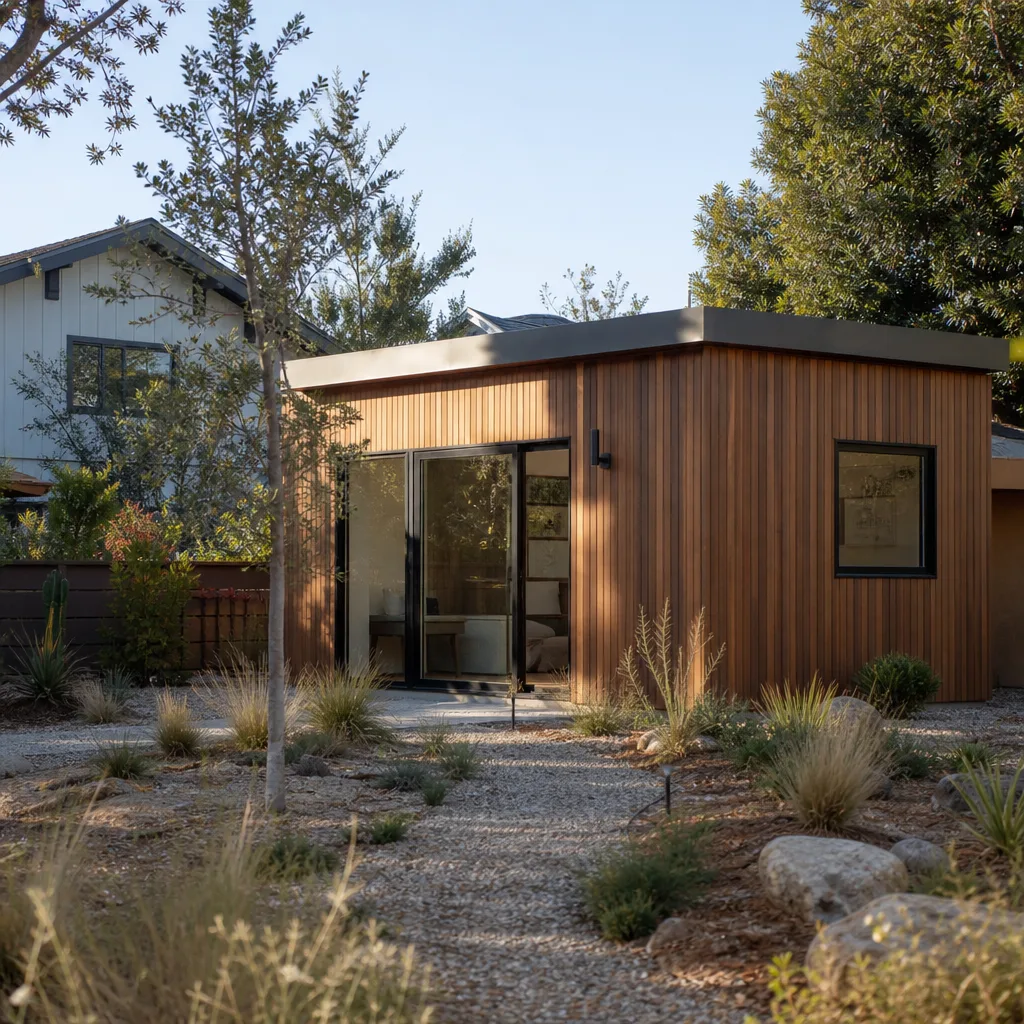
Mighty Buildings produces factory-fabricated panel systems primarily used in their detached accessory dwelling unit shells, but we frequently work with owners who purchased their panels for a junior ADU (JADU) conversion inside an existing home or attached garage. In Los Angeles, a JADU is capped at 500 square feet and must share at least one wall with the primary residence; that detail alone changes what parts you need from Mighty Buildings’ system.
If your Mighty Buildings kit arrived with composite wall panels, roof cassettes, or pre-wired conduit chases, the conversion-specific components that often need matching or replacement include the panel-to-slab anchor plates, utility chase covers, and interior finish trim profiles. These parts are cut to model-specific tolerances. You’ll find a silver spec label on the inside face of each wall panel near the bottom track: the first six digits identify the series, and the letter code after that identifies the panel position. Take a photo of that label before you call us or anyone else. It saves a trip.
On the OEM versus aftermarket question: for Mighty Buildings specifically, the anchoring hardware and chase covers should stay OEM. The panel geometry is proprietary, and aftermarket anchor plates often sit proud by an eighth of an inch, which creates a finish seam you’ll see forever. For finish trim, insulation infill, and the plumbing and electrical rough-in components that connect the kit to your house, quality aftermarket parts from names like CertainTeed, Viega, and Eaton work well and often cost less. We’ll tell you which is which on the estimate.
We’re an independent contractor authorized to build with Mighty Buildings products. We’re not affiliated with Mighty Buildings, which means we have no incentive to sell you a part you don’t need.
Signs Your Mighty Buildings Junior ADU Conversion Is Failing
- Hairline cracks at panel seams. The composite panels expand and contract at a different rate than your home’s wood framing. Los Angeles swings from 40-degree winter nights to 105-degree summer afternoons, and over two or three years those seams open up. The fix is usually new seam tape and a re-taped finish joint, not a panel replacement.
- Visible gap between the panel base track and your floor slab. This tells us the original anchor spacing wasn’t right for LA seismic movement. The panels shift a millimeter at a time during small quakes, and eventually the gap at the base track becomes visible along the baseboard line. It’s a safety item, not a cosmetic one.
- Doors or windows inside the conversion that bind or stick. Mighty Buildings panels are precisely machined, but once they’re anchored to a 1950s stucco house with its own settling pattern, the openings can shift. Binding usually means the frame connection hardware needs re-shimming.
- Draft or moisture staining where the conversion wall meets the existing house. This is the flashing junction. Mighty Buildings ships a transition profile for this joint, but if it was installed against a non-standard LA wall thickness (often 2×3 framing in older homes), the profile doesn’t seat correctly. Water finds the gap.
- Humming or rattling from the electrical chase covers. The pre-wired conduit inside Mighty Buildings panels vibrates when circuits draw heavy load. Loose chase covers amplify the sound. It’s a two-hour fix, not a rewire, but it’s annoying enough that people put it off for years.
Replacement Cost & What’s Included
Here’s what we actually bill for a Mighty Buildings junior ADU conversion in Los Angeles, priced in the ranges we’ve been seeing over the last eighteen months:
- Anchor system retrofit (per panel): $180 – $320 including epoxy and hardware
- Seam re-taping and finish (per linear foot): $8 – $14
- Chase cover replacement (per cover): $65 – $120
- Flashing transition rebuild at house junction: $1,200 – $2,400 depending on wall composition
- Full JADU conversion labor package (under 500 sf): $38,000 – $55,000 before finishes
Every quote includes parts, labor, trash hauling, and a written scope document. We don’t do change orders unless you change the scope. Troy Eastman has been building ADUs in LA since the city’s permitting overhaul made them practical, and he’ll tell you the same thing on the phone: if a contractor gives you a verbal number and no written breakdown, you’re about to pay more.
Every Mighty Buildings conversion we complete is covered by our 365-Day Done Right Promise. If the work isn’t right within a year, we return and make it right. No re-inspection fees, no arguing about whose fault it was.
DIY or Call Us?
You can safely inspect the label on each panel, photograph the seam gaps, and check for moisture with a $15 pin meter from a hardware store. If the chase cover is rattling, you can tight the screws. That’s about where we draw the line.
The anchor system is the dangerous part. Those plates hold composite panels against seismic shear forces. Undersized anchors or misaligned brackets fail suddenly, and a 300-pound panel carries enough energy during a quake to injure someone on the other side. This is not a trade secret to protect our work; it’s a warning we give every owner who calls about panel separation. Let a trained technician handle anything touching the anchors. We’ll match the OEM spec, and the estimate is free. Call (903) 568-7222.
FAQs
The composite panels themselves carry a 30-plus-year lifespan, but the conversion joints (anchors, flashing, seams) need attention every 8 to 12 years in LA’s dry-heat-and-rain cycle. Plan for re-taping the seams roughly every decade. Call (903) 568-7222 and we’ll walk you through what we see on your specific panel series.
In nearly all cases, yes. Panels with surface cracks can be re-taped and refinished. Only structural delamination (which is rare and usually follows water intrusion) requires panel replacement. We’ll always show you the moisture readings before recommending replacement.
A seam re-tape and chase cover replacement takes one day. A full anchor system retrofit on a 500-square-foot JADU takes two to three days including epoxy cure time. We give you a written schedule before we start and text you photos when the crew arrives and when they finish.
We stock the common items: seam tape, chase covers, anchor plate kits, and transition flashing profiles. If your panel series needs a part that’s specific to your model year, we order direct from Mighty Buildings and it’s typically on hand within a week. You’ll see the part cost on the written estimate before we order it.
Written by Troy Eastman, Owner & Lead Builder, Benson ADU Builders at Benson ADU Builders, serving Los Angeles and nearby areas.