Last updated October 9, 2026
How Long Does ADU Builders Take? Timelines and What to Expect
A contractor who quotes you a “six-month ADU” without separating permit time from build time is either guessing or hoping you won’t notice the difference when month eight arrives and you’re still waiting on the city. In Los Angeles, the honest answer to this question is two answers: roughly 4 to 6 months for permits and approvals, then another 4 to 8 months for construction, depending on whether you go site-built or prefab. This guide breaks down both phases, names the delays most builders won’t mention until they happen, and gives you the questions to ask before you sign anything. For more guides & resources, see our blog. We build ADUs in Los Angeles every day, and the timelines below reflect what we actually see, not brochure numbers.
Quick Answer
Building an ADU in Los Angeles typically takes 8 to 14 months from first design meeting to final inspection. The permit and approval phase runs 4 to 6 months on average, and the construction phase adds 4 to 8 months. Prefab ADUs can shorten construction to 2 to 4 months on site, but the permit phase stays roughly the same unless a pre-approved plan program applies.
Table of Contents
- The Design Phase: 4 to 8 Weeks
- The Permit Phase: The Timeline Nobody Quotes
- The Construction Phase: Site-Built vs. Prefab
- The Five Delays That Extend Every ADU Timeline
- How Pre-Approved ADU Plans Cut Permit Time
- What Real-Time Tracking Changes About Waiting
- How Timeline Affects Cost in Los Angeles
The Design Phase: 4 to 8 Weeks
Before any timeline starts, your ADU has to get drawn, engineered, and priced. In Los Angeles, design takes 4 to 8 weeks for a standard detached ADU or garage conversion. This includes site measurement, architectural drawings, structural engineering, Title 24 energy calculations, and a soils report if your lot requires one. The soils report matters because it dictates the foundation design, and foundation changes ripple through the entire project.
Here’s what the design phase actually includes, in order:
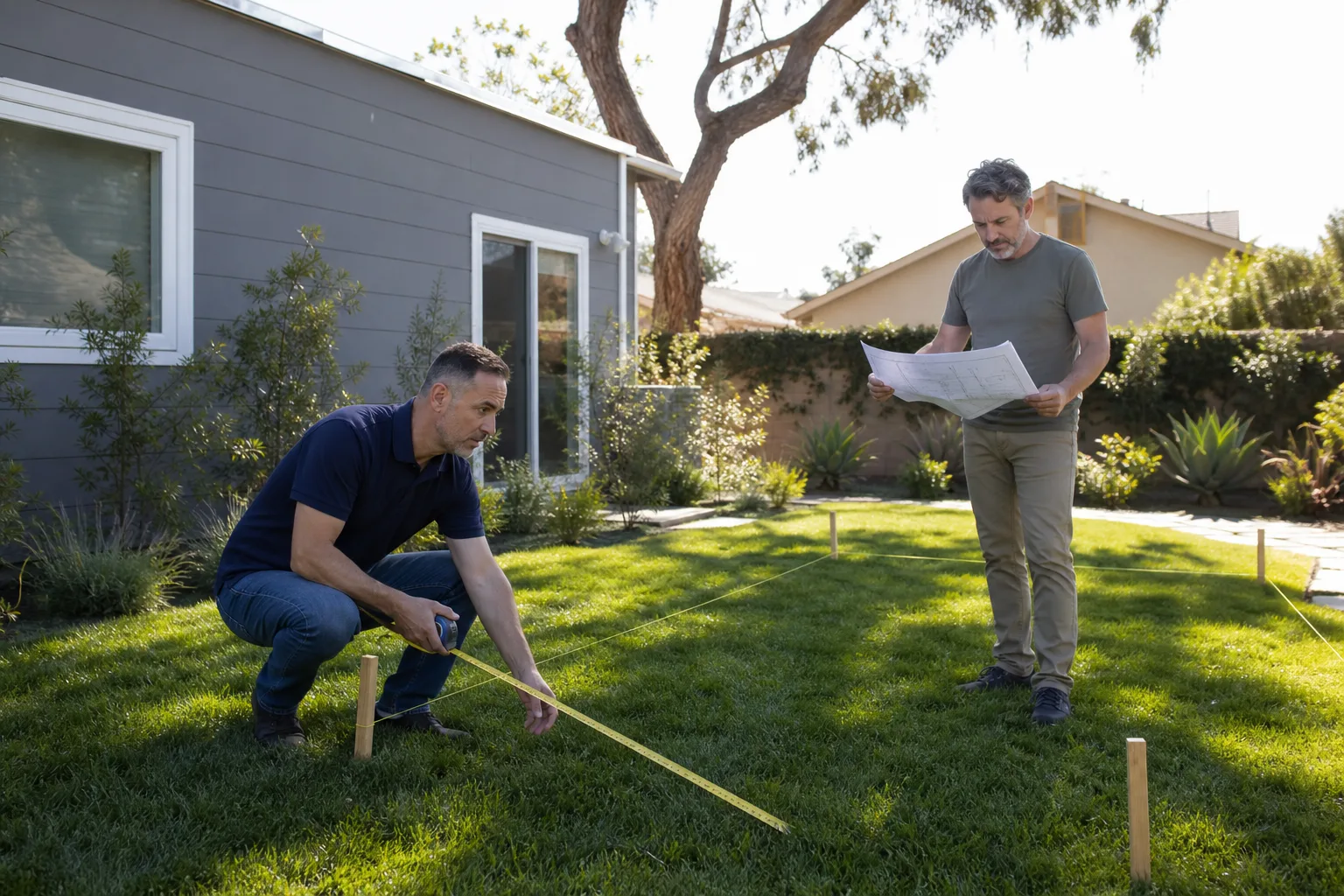
- Site assessment (week 1): measuring the lot, checking setbacks, and confirming what fits. A setback is the required distance between a structure and the property line, and LA’s ADU ordinance allows a 4-foot rear and side setback for most standard lots.
- Architectural drawings (weeks 2 to 4): floor plan, elevations, roof design, window and door placement.
- Structural engineering (weeks 3 to 5): foundation plan, shear wall details, and any hillside or soft-story requirements if your lot has slope or is in a seismic zone.
- Title 24 energy compliance (week 5): mandatory energy calculations that affect insulation, glazing, and HVAC sizing.
- Soils report (weeks 2 to 6): ordered in parallel with design, but the results can force engineering changes if the soil is expansive or poorly compacted.
- Fixed-price estimate (week 6 to 8): the written number that should follow every design decision. At Benson ADU Builders, this is a written price before any work starts, tied to the exact drawings and specifications, so the number doesn’t drift when material costs shift.
The big variable here is the soils report. Some lots in Los Angeles neighborhoods like Sherman Oaks or Silver Lake sit on hillside fill that needs deeper footings or a mat slab, and that revision can add 2 to 3 weeks to design alone. A good builder flags this risk in the first meeting instead of letting it surface as a surprise change order later.
The Permit Phase: The Timeline Nobody Quotes
Permit review with the Los Angeles Department of Building and Safety (LADBS) runs 8 to 20 weeks for most ADUs. The range depends on whether you submit under the standard plan check process or use a pre-approved plan, and whether your project triggers additional city department reviews like Bureau of Engineering or Planning.
Here’s a realistic breakdown of the LA permit phase:
- Plan check submission to first comments: 4 to 8 weeks. LADBS typically issues its first round of corrections within this window.
- Corrections and resubmission: 2 to 4 weeks per round. Most ADUs go through two rounds of corrections.
- Utility approvals: 2 to 6 weeks. LADWP and SoCalGas approvals for new service connections, sewer lateral checks, and gas line taps happen in parallel but frequently hold up the final permit.
- Permit issuance: 1 to 2 weeks after all departments sign off.
The total is 8 to 20 weeks on average, but we’ve seen straightforward garage conversions clear in 6 weeks and detached new builds with hillside grading take 24. The key question to ask any builder is whether their quoted timeline includes the permit phase or starts at permit issuance (see How Long Does Home Addition Contractor Take? Timelines and What to Expect for comparison). Many quote the latter because it’s shorter, then blame the city when the real total stretches past a year.
At Benson ADU Builders, we track permit status weekly and share the city’s comments with you as they come in. You’ll know what the city asked for and what we changed, not just that there’s a delay.
The Construction Phase: Site-Built vs. Prefab
Construction timelines in Los Angeles split into two clear paths. Site-built ADUs run 4 to 8 months. Prefab ADUs run 2 to 4 months on site after the foundation is ready, but that foundation still takes 4 to 8 weeks on its own.
Here’s a side-by-side comparison:
| Phase | Site-Built ADU | Prefab ADU |
|---|---|---|
| Site prep and demo | 2 to 4 weeks | 2 to 4 weeks |
| Foundation | 3 to 6 weeks | 3 to 6 weeks |
| Framing / module delivery | 4 to 6 weeks | 1 to 2 days |
| Mechanical, electrical, plumbing | 6 to 10 weeks | 3 to 5 weeks (site connections) |
| Drywall, finish, fixtures | 6 to 10 weeks | 3 to 5 weeks |
| Final inspection and closeout | 1 to 2 weeks | 1 to 2 weeks |
| Total on-site construction | 4 to 8 months | 2 to 4 months |
The prefab timeline advantage is real, but it’s not magic. Foundation and utility work don’t disappear. A prefab module from a brand like Dvele or Boxabl arrives on a truck fully framed and partially finished, but it still needs a poured foundation, water and sewer connections, electrical panel tie-in, and gas or heat pump lines. We’ve watched homeowners assume prefab means a two-week project and then feel cheated when the foundation takes a month. The honest framing is that prefab compresses framing and finish time, not site work.
We build with several prefab brands including Dvele, Mighty Buildings, and Boxabl, and we walk every client through the real site schedule for each option before they commit. No brand changes the laws of concrete curing.
The Five Delays That Extend Every ADU Timeline
Every city has its own version of these five problems. Here’s what we see repeatedly in Los Angeles and how a good builder hedges against each one.
- Utility trenching holds. New water, sewer, or electrical service often requires trenching through a public sidewalk or street, which triggers LADWP or SoCalGas inspection cycles and sometimes a separate permit. This can pause a project for 3 to 8 weeks if not scheduled early. A builder who pulls utility permits in the first month of construction avoids most of this.
- Soils report surprises. Expansive soils or hidden debris can force a foundation redesign after construction starts. The fix is ordering the soils report during design, not after demo, so the foundation is engineered for reality the first time.
- HOA review. If your property falls under an HOA, some associations require design review before construction starts, even though California law limits their ability to block ADUs. That review can add 2 to 6 weeks if it wasn’t initiated during the permit phase.
- Inspector scheduling backlogs. LADBS inspectors are stretched across an enormous city, and certain inspections like shear wall nailing or concrete pour can sit waiting for a day or two. We schedule inspections for early morning windows and keep a backup task list ready for days when an inspector can’t reach us, so the crew doesn’t stand idle.
- Subcontractor sequencing. The plumbing rough-in has to pass inspection before the slab can be poured, and the slab has to cure before framing starts. One missed sub can idle every trade after it. A builder with a written schedule and weekly updates flags these dependencies early instead of quietly sliding the move-in date.
None of these delays are unique to ADUs in Los Angeles, but they compound faster here because land is tight, city departments are busy, and most lots are older with surprises waiting underground. The mitigation is the same in every case: pull permits early, order reports before demo, and keep the schedule visible week by week.
How Pre-Approved ADU Plans Cut Permit Time
The City of Los Angeles runs a pre-approved ADU plan program, and it’s the single biggest permit accelerant most homeowners never hear about. Plans that have already passed LADBS structural and zoning review can cut permit review from the standard 8 to 20 weeks down to 2 to 6 weeks. That’s a 6 to 10 week savings on paper.
Several prefab manufacturers have designs already in the LA pre-approved catalog. Abodu and Cover are the most visible names, which is part of why these brands move faster in LA than a custom site-built design. When we build with a pre-approved plan, the design phase compresses too, because the architecture and engineering are already locked.
Here’s what changes with a pre-approved plan:
- Design phase: shortens from 4 to 8 weeks to 2 to 4 weeks, since drawings already exist.
- Permit review: shrinks from 8 to 20 weeks to 2 to 6 weeks, subject to site-specific checks like the soils report and utility connections.
- Total pre-construction: drops from roughly 4 to 6 months to 2 to 3 months.
The catch is that pre-approved plans still need site-specific engineering, especially for foundation work on sloped or unusual lots. The plan itself is approved, but your lot isn’t. We handle that gap by ordering the soils report and any grading checks on day one, so the pre-approved speed isn’t wasted waiting on site data.
What Real-Time Tracking Changes About Waiting
Most ADU frustration is not about the length of the timeline. It’s about the silence. A homeowner who waits six weeks without hearing from a contractor assumes the worst, calls three times, gets one vague text, and spends the next month anxious. The same six weeks with a weekly photo, a short update on what the city asked for, and a confirmed date for the next milestone feels entirely different.
That’s the premise behind the Relay Visibility system we use at Benson ADU Builders. Every project gets real-time tracking: a written schedule before construction starts, photo updates as work progresses, before-and-after documentation at each phase, and a digital invoice payable by link at the end. You don’t have to call to find out what happened this week. It’s in your phone already.
This matters for timeline math in a practical way. When a city department adds two weeks to a permit review, we can show you the city’s comment letter and our resubmission date the same day. When an inspector reschedules, you get a notification with the new date. The delay is still a delay, but you’re not inventing worst-case scenarios in the absence of information.
For homeowners who manage their lives from their phones, this is the difference between a project that feels under control and one that feels like it’s happening to you. You cannot eliminate every delay in Los Angeles, but you can eliminate the information blackout that makes delays feel like negligence.
How Timeline Affects Cost in Los Angeles
Longer timelines cost more, and it’s not just labor. Every month a project runs beyond its schedule adds holding costs: continued insurance, portable toilet rental, fencing, temporary power, and often a second mobilization if a trade has to return. In Los Angeles, a one-month delay on an ADU typically adds $2,000 to $3,500 in carrying costs before any scope change.
Here’s what a realistic Los Angeles detached ADU budget looks like by phase, including the time tied to each:
| Phase | Typical Duration | Typical Cost Range |
|---|---|---|
| Design and engineering | 4 to 8 weeks | $8,000 to $20,000 |
| Permits and city fees | 8 to 20 weeks | $8,000 to $25,000 |
| Site prep and foundation | 4 to 8 weeks | $30,000 to $70,000 |
| Construction (site-built or module set) | 4 to 8 months | $120,000 to $250,000 |
| Finishes, utilities, and closeout | 3 to 6 weeks | $20,000 to $50,000 |
These are ranges, not quotes, because every lot in Los Angeles is different. A flat lot in the Valley runs differently from a hillside in Echo Park. What we can tell you is the written price: at Benson ADU Builders, every component is priced before construction starts, and the number on your estimate is the number you pay unless you change the scope. No timeline-linked change orders, no surprise line items when a delay happens.
The most expensive ADU is the one that takes 18 months because the builder didn’t sequence the permits right. The second most expensive is the one priced vaguely from day one. The cheapest path is usually the boring one: a written schedule, a fixed price, and a builder who tells you when things shift in plain English.
Common Mistakes to Avoid
- Signing a contract with a single combined “6-month ADU” timeline. If the builder won’t separate permit time from construction time, you don’t actually have a schedule. You have a guess.
- Waiting to order the soils report until after demo starts. In Los Angeles, this one sequencing error can add 3 to 5 weeks and force a foundation redesign.
- Assuming prefab skips site work. Prefab brands like Plant Prefab or Mighty Buildings still require foundation, utility, and permitting work on your lot. The module is fast; the ground underneath it is not.
- Ignoring utility permits until framing is done. New electrical service or sewer connections can take weeks of their own review through LADWP. Pull those permits early.
- Picking the cheapest bid without a written schedule. The low bid often assumes the best-case timeline with no buffer, and every delay becomes a change order.
- Not asking how the builder communicates during the project. A contractor who only calls when there’s a problem is managing the problem, not the project.
When to Call a Professional
You should call a builder the moment you have a rough idea of your budget and your lot’s feasibility, even if you’re 6 months from breaking ground. In Los Angeles, the pre-construction phase routinely takes 4 to 6 months, so starting the conversation early means the permit clock runs while you finalize financing. Call an ADU professional if you have a hillside lot, if your property is in an HOA, if you plan to add a separate utility service, or if you’re deciding between site-built and prefab and want a real cost comparison instead of manufacturer marketing. Benson ADU Builders offers free estimates in Los Angeles, and we’ll give you a written schedule and price from the first conversation. Call (903) 568-7222 to schedule yours.
Frequently Asked Questions
Expect 8 to 14 months total: 4 to 6 months for design and permits, then 4 to 8 months for construction. Prefab ADUs can reduce construction to 2 to 4 months on site, and pre-approved plans can cut the permit phase to 2 to 6 weeks.
The LADBS plan check process typically takes 4 to 8 weeks for first comments, and most projects go through two or more correction rounds. Utility approvals from LADWP and SoCalGas also run in parallel and frequently hold up final permit issuance even after the building plans are approved.
Yes. Using a pre-approved plan from the City of LA catalog can cut permit review by 6 to 10 weeks. Ordering your soils report during design, pulling utility permits early, and choosing a builder who sequences inspections and subcontractors tightly all shave weeks off the total.
Faster on construction: prefab typically runs 2 to 4 months on site versus 4 to 8 months for site-built (How Long Does Room Addition Contractor Take? Timelines and What to Expect). But foundation, utility connections, and permits take the same time regardless of construction method, so the total project timeline is reduced, not halved.
Utility trenching and connection approvals cause the most avoidable delays we see. New sewer laterals, water service, and electrical panel work all require separate utility review that can take 3 to 8 weeks if not initiated early in construction.
A detached ADU typically runs $180,000 to $350,000 all-in, including design, permits, site work, and construction. Garage conversions run lower, often $120,000 to $200,000, because the foundation and shell already exist. Call (903) 568-7222 for an exact quote with written pricing.
The Bottom Line
The real answer to “how long does ADU builders take” in Los Angeles is 8 to 14 months, split into a permit phase you can’t fully control and a construction phase a good builder can. The builders with the shortest real-world timelines are the ones who separate those two numbers up front, pull utility permits early, order the soils report before demo, and keep you informed every week. The builders with the longest timelines are the ones who quote one optimistic number and then let the city take the blame. Ask for the phase-by-phase schedule in writing, and walk away from anyone who won’t give it to you. Learn more at Benson ADU Builders home, or explore our ADU Builders in Los Angeles page. We also offer home addition contractor and room addition services in Los Angeles.
Written by Troy Eastman, Owner at Benson ADU Builders, serving Los Angeles since 2006.